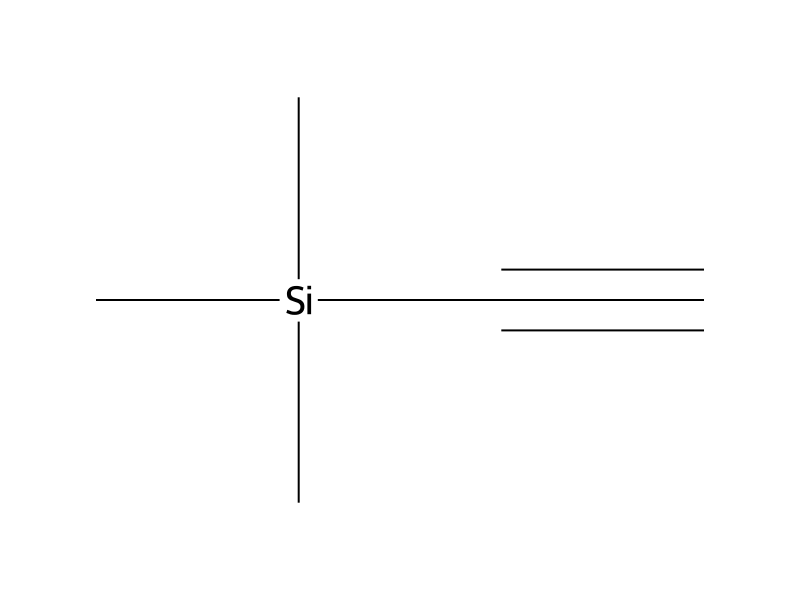
[CH3:1][Si:2]([C:5]#[CH:6])([CH3:4])[CH3:3].Br[C:8]1[S:12][C:11]([C:13](=[O:15])[CH3:14])=[CH:10][C:9]=1[CH3:16].C(N(CC)CC)C>CN(C=O)C.Cl[Pd](Cl)([P](C1C=CC=CC=1)(C1C=CC=CC=1)C1C=CC=CC=1)[P](C1C=CC=CC=1)(C1C=CC=CC=1)C1C=CC=CC=1.[Cu]I>[CH3:16][C:9]1[CH:10]=[C:11]([C:13](=[O:15])[CH3:14])[S:12][C:8]=1[C:6]#[C:5][Si:2]([CH3:4])([CH3:3])[CH3:1]Trimethylsilylacetylene (16 ml) is added to a solution of 1-(5-bromo-4-methyl-thiophen-2-yl)-ethanone (16.9 q, example 1, step A), Pd(PPh3)2Cl2 (3.78 g), CuI (1.46 g) and triethylamine (16 ml) in DMF (15 ml). After 3 hours at room temperature, the reaction is quenched with water and extracted three times with ethyl acetate. The organic phases are combined, dried over Na2SO4 and concentrated in vacuo. The crude product is purified by filtration over a plug of silica gel eluting with dichloromethane to yield 1-(4-methyl-5-trimethylsilanylethynyl-thiophen-2-yl)-ethanone (18.2 g) as yellow solid. The compound is used without further purification.