HomeMCPWorkbenchSkills
HomeWorkbenchNotificationsMe
llms.txt · MCP GuidePrivacy Policy · Terms of Service · Supportv1.8.3
  1. Home
  2. /Reaction

Hydrogen Peroxide → 1-(2,6-Dimethyl-4-nitrophenyl)-3-(2-hydroxyethyl)pyridin-2(1H)-one

HRID 391749
Print

Reaction equation

HRID 391749 reaction equation
C12BC(CCC1)CCC2.[CH3:10][C:11]1[CH:16]=[C:15]([N+:17]([O-:19])=[O:18])[CH:14]=[C:13]([CH3:20])[C:12]=1[N:21]1[CH:26]=[CH:25][CH:24]=[C:23]([CH:27]=[CH2:28])[C:22]1=[O:29].[OH-:30].[Na+].OO>O1CCCC1.C(OCC)(=O)C.O>[CH3:10][C:11]1[CH:16]=[C:15]([N+:17]([O-:19])=[O:18])[CH:14]=[C:13]([CH3:20])[C:12]=1[N:21]1[CH:26]=[CH:25][CH:24]=[C:23]([CH2:27][CH2:28][OH:30])[C:22]1=[O:29]
ParticipantsProcedureWorkupSources & evidenceReaction notes

Participants

8

Reactant 4

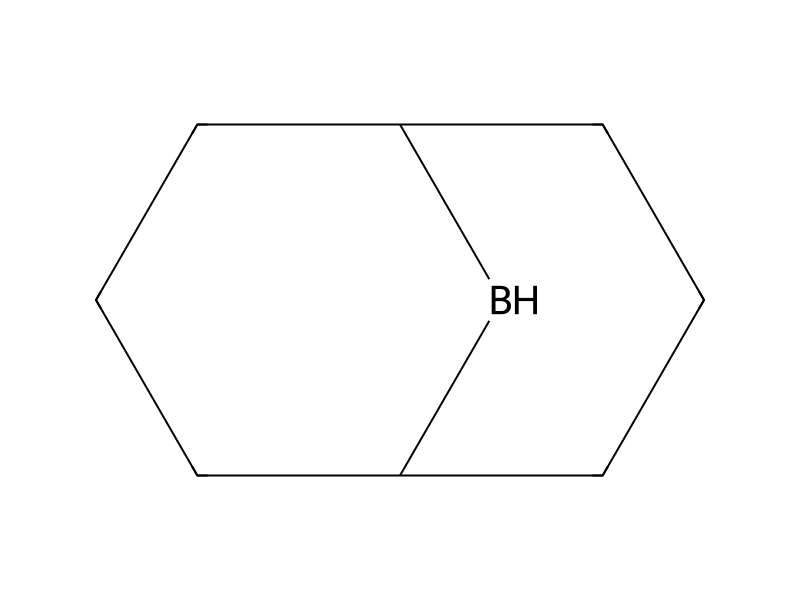
HCID 784Hydrogen PeroxideHCID 14798Sodium HydroxideHCID 789669-Borabicyclo(3.3.1)nonaneHCID 594101691-(2,6-Dimethyl-4-nitrophenyl)-3-vinylpyridin-2(1H)-one

Product 1

HCID 545754381-(2,6-Dimethyl-4-nitrophenyl)-3-(2-hydroxyethyl)pyridin-2(1H)-one

Reagents, catalysts & solvents 3

HCID 962
Water
Solvent
HCID 8028TetrahydrofuranSolvent
HCID 8857Ethyl AcetateSolvent

Procedure

With ice-cooling, 1.15 l (575 mmol) of a 0.5 molar solution of 9-borabicyclo[3.3.1]nonane in tetrahydrofuran are added to 70.7 g (262 mmol) of the compound from Example 60A (alternative synthesis) such that the internal temperature does not exceed 10-15° C. The mixture is then warmed to RT and stirred at room temperature for 1.5 h. The mixture is then cooled and, at 0° C.-5° C., 653 ml (1.31 mol) of a 2-molar aqueous solution of sodium hydroxide are added. The mixture is stirred briefly, and 296 g (2.51 mol) of a 30% strength hydrogen peroxide solution are then added such that the temperature does not exceed 30° C. and does not fall below 25° C. After the addition has ended, the mixture is stirred for another 30 min. Water and ethyl acetate are added to the reaction mixture. After phase separation, the aqueous phase is once more extracted with ethyl acetate. The combined organic phases are washed with an aqueous sodium bisulphite solution. The organic phase is removed and evaporated to dryness under reduced pressure. The residue is dissolved in dichloromethane and purified by chromatography on silica gel (cyclohexane/ethyl acetate 1:2, then ethyl acetate). This gives 66.5 g (88% of theory) of the desired product.

Workup

  1. temperatureWith ice-cooling
  2. customdoes not exceed 10-15° C
  3. temperatureThe mixture is then cooled and, at 0° C.-5° C.
  4. stirringThe mixture is stirred briefly
  5. customdoes not exceed 30° C.
  6. customdoes not fall below 25° C
  7. additionAfter the addition
  8. stirringthe mixture is stirred for another 30 min
  9. customAfter phase separation
  10. extractionthe aqueous phase is once more extracted with ethyl acetate
  11. washThe combined organic phases are washed with an aqueous sodium bisulphite solution
  12. customThe organic phase is removed
  13. customevaporated to dryness under reduced pressure
  14. dissolutionThe residue is dissolved in dichloromethane
  15. custompurified by chromatography on silica gel (cyclohexane/ethyl acetate 1:2

Sources & evidence

ORD record
ord-f58a8e91ad554e49bbc41e37042b6adb
Source dataset
uspto-grants-2013_02
DOI
10.6084/m9.figshare.5104873.v1
Patent number
US08383822B2

Reaction notes

On this pageParticipantsProcedureWorkupSources & evidenceReaction notes