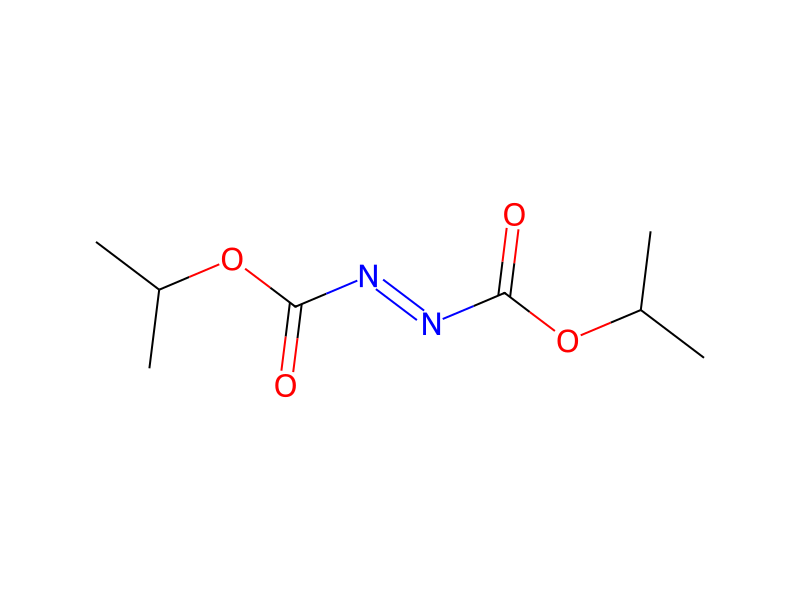
[Br:1][C:2]1[S:14][C:5]2=[N:6][C:7]([Cl:13])=[C:8]([CH:10](O)[CH3:11])[CH:9]=[C:4]2[CH:3]=1.[C:15]1(=[O:25])[NH:19][C:18](=[O:20])[C:17]2=[CH:21][CH:22]=[CH:23][CH:24]=[C:16]12.C1(P(C2C=CC=CC=2)C2C=CC=CC=2)C=CC=CC=1.CC(OC(/N=N/C(OC(C)C)=O)=O)C>C1COCC1>[Br:1][C:2]1[S:14][C:5]2=[N:6][C:7]([Cl:13])=[C:8]([CH:10]([N:19]3[C:15](=[O:25])[C:16]4[C:17](=[CH:21][CH:22]=[CH:23][CH:24]=4)[C:18]3=[O:20])[CH3:11])[CH:9]=[C:4]2[CH:3]=1To a round-bottomed flask containing 1-(2-bromo-6-chlorothieno[2,3-b]pyridin-5-yl)ethanol (2.0 g, 6.8 mmol), pthalimide (1.2 g, 8.2 mmol, 1.2 eq), and triphenylphosphine (2.15 g, 8.2 mmol) was added THF (45 mL). The solution was cooled to 0° C. and diisopropylazodicarboxylate (DIAD, 1.6 mL, 8.2 mmol, 1.2 eq) was added dropwise. The reaction was allowed to warm to room temperature. After 1 h, the reaction was judged to be complete by LC/MS. The solvent was removed in vacuo and the residue was redissolved in ether and washed with water. The water layer was back extracted with ether. The combined ether layers were washed with brine and dried over MgSO4, filtered, and concentrated. The crude product was purified by column chromatography using 15% EA in hexanes to afford 2-(1-(2-bromo-6-chlorothieno[2,3-b]pyridin-5-yl)ethyl)isoindoline-1,3-dione. LC/MS (M+1, found=422.8). 1H NMR (400 MHz, CDCl3) δ 8.40 (s, 1H), 7.82 (m, 2H), 7.72 (m, 2H), 5.92 (q, J=7.0 Hz, 1H), 1.92 (d, J=7.0 Hz, 3H) ppm.