HomeMCPWorkbenchSkills
HomeWorkbenchNotificationsMe
llms.txt · MCP GuidePrivacy Policy · Terms of Service · Supportv1.8.0
  1. Home
  2. /Reaction

Sodium Bicarbonate → Benzyl 2-benzyloxy-4-(4,4,5,5-tetramethyl-1,3,2-dioxaborolan-2-yl)benzoate

HRID 454467
Notes
Print preview

Reaction equation

HRID 454467 reaction equation
B1([B:10]2[O:14][C:13]([CH3:16])([CH3:15])[C:12]([CH3:18])([CH3:17])[O:11]2)OC(C)(C)C(C)(C)O1.C([O-])(=O)C.[K+].C1(P(C2CCCCC2)C2CCCCC2)CCCCC1.C1(C)C=CC=CC=1.[CH2:50]([O:57][C:58]1[CH:73]=[C:72](Cl)[CH:71]=[CH:70][C:59]=1[C:60]([O:62][CH2:63][C:64]1[CH:69]=[CH:68][CH:67]=[CH:66][CH:65]=1)=[O:61])[C:51]1[CH:56]=[CH:55][CH:54]=[CH:53][CH:52]=1.C(=O)(O)[O-].[Na+]>C1C=CC(/C=C/C(/C=C/C2C=CC=CC=2)=O)=CC=1.C1C=CC(/C=C/C(/C=C/C2C=CC=CC=2)=O)=CC=1.C1C=CC(/C=C/C(/C=C/C2C=CC=CC=2)=O)=CC=1.[Pd].[Pd].C(OCC)(=O)C.O1CCOCC1>[CH2:50]([O:57][C:58]1[CH:73]=[C:72]([B:10]2[O:11][C:12]([CH3:17])([CH3:18])[C:13]([CH3:15])([CH3:16])[O:14]2)[CH:71]=[CH:70][C:59]=1[C:60]([O:62][CH2:63][C:64]1[CH:65]=[CH:66][CH:67]=[CH:68][CH:69]=1)=[O:61])[C:51]1[CH:52]=[CH:53][CH:54]=[CH:55][CH:56]=1
ParticipantsProcedureWorkupSources & evidenceReaction notes

Participants

9

Reactant 5

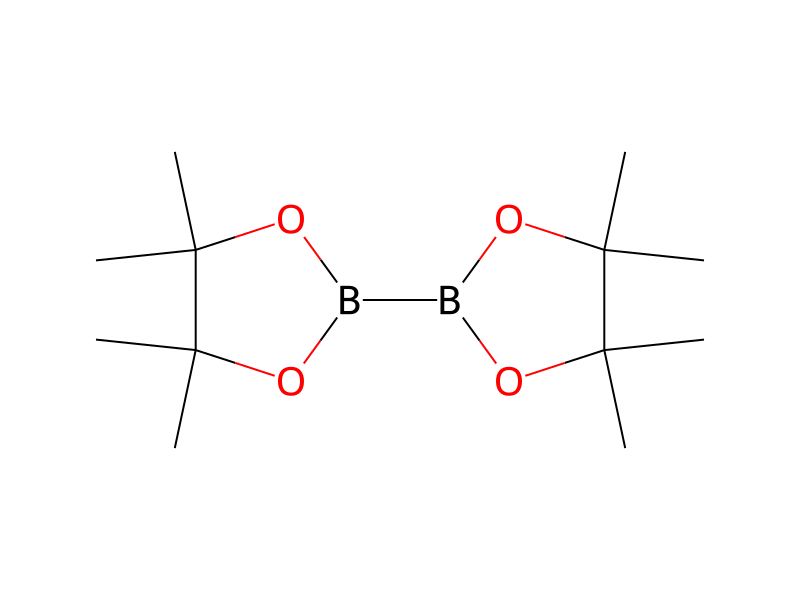
HCID 516892Sodium BicarbonateHCID 517044Potassium AcetateHCID 2733548Bis(pinacolato)diboraneHCID 66835618Tricyclohexylphosphine toluene2×HCID 66989997Benzyl 2-(benzyloxy)-4-chlorobenzoate

Product 1

HCID 23090759
Benzyl 2-benzyloxy-4-(4,4,5,5-tetramethyl-1,3,2-dioxaborolan-2-yl)benzoate

Reagents, catalysts & solvents 3

HCID 9811564Bis(dibenzylideneacetone)palladiumCatalyst2×HCID 8857Ethyl AcetateSolventHCID 312751,4-DioxaneSolvent

Procedure

Bis(pinacolato)diboron (0.41 g), potassium acetate (0.25 g), tris(dibenzylideneacetone)dipalladium(0) (46 mg), and a 15% tricyclohexylphosphine-toluene solution (0.25 mL) were added to a dioxane (3.5 mL) solution of benzyl 2-(benzyloxy)-4-chlorobenzoate (0.35 g), followed by stirring under a nitrogen atmosphere at room temperature for 30 minutes and then at 80° C. for 5 hours and 30 minutes. After cooling the reaction mixture to room temperature, tris(dibenzylideneacetone)dipalladium(0) (46 mg) and a 15% tricyclohexylphosphine-toluene solution (0.25 mL) were added thereto, followed by stirring under a nitrogen atmosphere at 90° C. for 8 hours. After cooling the reaction mixture to room temperature, a saturated aqueous solution of sodium bicarbonate and ethyl acetate were added thereto, and the insoluble substance was removed by filtration. The organic layer was separated, washed with a saturated aqueous solution of sodium chloride, and dried over anhydrous magnesium sulfate, and the solvent was evaporated under reduced pressure. The obtained residue was purified by silica gel column chromatography [Fuji Silysia Chemical Ltd., PSQ100B (spherical), eluent: 100-75% hexane/ethyl acetate] to obtain benzyl 2-(benzyloxy)-4-(4,4,5,5-tetramethyl-1,3,2-dioxaborolan-2-yl)benzoate.


Workup

  1. waitat 80° C. for 5 hours
  2. custom30 minutes
  3. temperatureAfter cooling the reaction mixture to room temperature
  4. stirringby stirring under a nitrogen atmosphere at 90° C. for 8 hours
  5. temperatureAfter cooling the reaction mixture to room temperature
  6. customthe insoluble substance was removed by filtration
  7. customThe organic layer was separated
  8. washwashed with a saturated aqueous solution of sodium chloride
  9. dry with materialdried over anhydrous magnesium sulfate
  10. customthe solvent was evaporated under reduced pressure
  11. customThe obtained residue was purified by silica gel column chromatography [Fuji Silysia Chemical Ltd., PSQ100B (spherical), eluent: 100-75% hexane/ethyl acetate]

Sources & evidence

ORD record
ord-45f5a29f95484a1da11fccbc6f0edd17
Source dataset
uspto-grants-2013_07
DOI
10.6084/m9.figshare.5104873.v1
Patent number
US08492582B2

Reaction notes

Loading…

On this pageParticipantsProcedureWorkupSources & evidenceReaction notes