Reaction equation

[CH:1]([C:4]1[CH:10]=[CH:9][C:7]([NH2:8])=[CH:6][CH:5]=1)([CH3:3])[CH3:2].C(=O)([O-])[O-].[K+].[K+].Br[CH2:18][CH:19]([O:23][CH2:24][CH3:25])[O:20][CH2:21][CH3:22]>CN(C=O)C>[CH:1]([C:4]1[CH:10]=[CH:9][C:7]([NH:8][CH2:18][CH:19]([O:23][CH2:24][CH3:25])[O:20][CH2:21][CH3:22])=[CH:6][CH:5]=1)([CH3:3])[CH3:2]Participants
Reactant 3
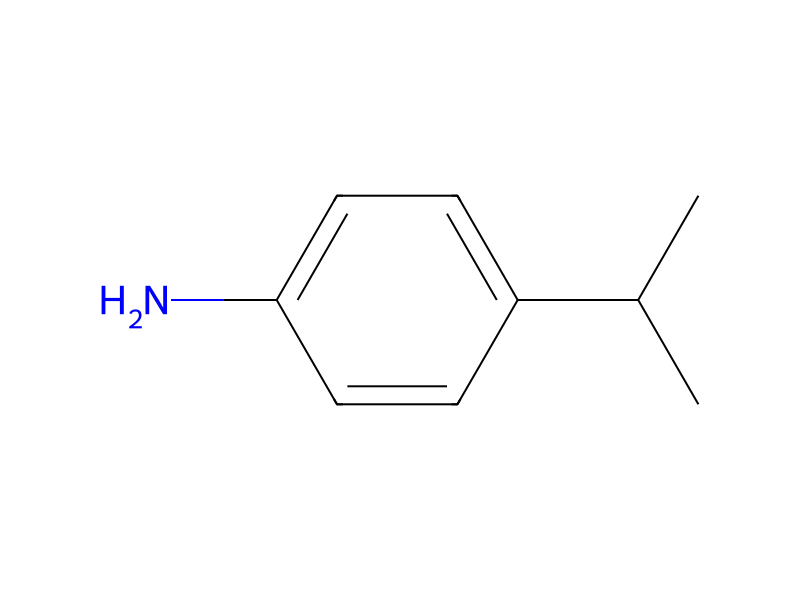


Product 1

Reagents, catalysts & solvents 1

Procedure
To a mixture of 4-isopropylaniline (4.05 g, 30.0 mmol) and potassium carbonate (6.21 g, 45 mmol) in DMF (100 mL) at room temperature was added 2-bromo-1,1-diethoxyethane (6.50 g, 33.0 mmol). The mixture was then stirred at 80-90° C. until all of the 4-isopropylaniline was consumed (24 h). The solvent was removed in vacuo and the residue was treated with dichloromethane (150 mL), washed with water and brine, dried over anhydrous MgSO4, and then concentrated. Chromatography (silica gel, hexanes:ethyl acetate, 9:1) of the crude product, furnished the pure intermediate, N-(4-isopropylphenyl)-2,2-diethoxyethylamine, as a colorless oil (5.71 g, 75.8%). 1H NMR (CDCl3, 300 MHz) δ (ppm) 1.18-1.32(m, 12H), 2.75-2.91 (m, 1H), 3.24 (d, 2H), 3.52-3.62 (m, 2H), 3.67-3.79 (m, 2H), 3.87 (s, br, 1H), 4.70 (t, 1H), 6.60 (d, 2H), 7.05 (d, 2H).
Workup
- customwas consumed (24 h)
- customThe solvent was removed in vacuo
- additionthe residue was treated with dichloromethane (150 mL)
- washwashed with water and brine
- dry with materialdried over anhydrous MgSO4
- concentrationconcentrated
Sources & evidence
- ORD record
- ord-3a0559b37322410fb17ad3f598e60a5b
- Source dataset
- uspto-grants-2011_03
- Patent number
- US07902241B2
Linked notes
Loading…