Reaction equation
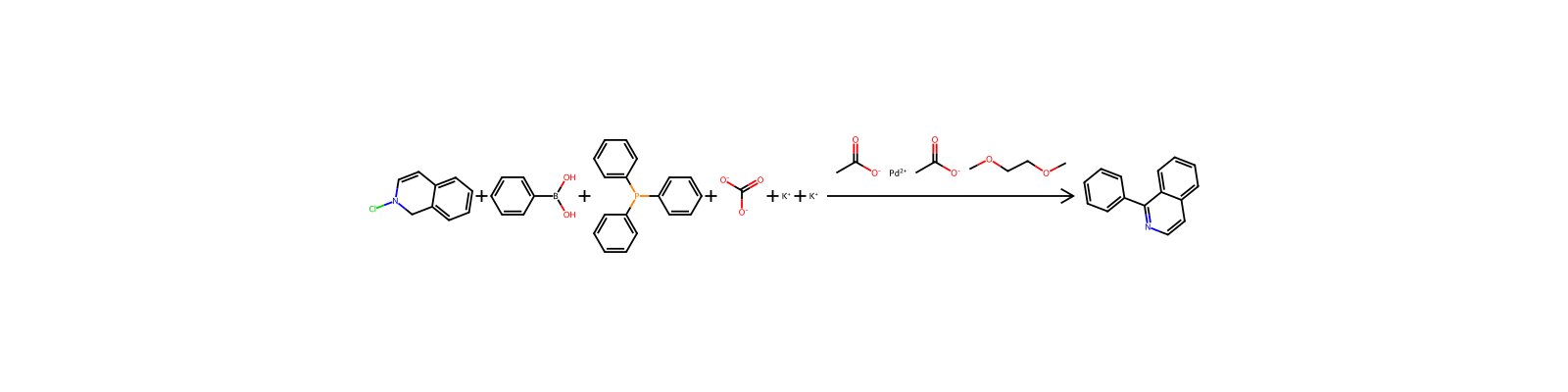
Cl[N:2]1[CH:11]=[CH:10][C:9]2[C:4](=[CH:5][CH:6]=[CH:7][CH:8]=2)[CH2:3]1.[C:12]1(B(O)O)[CH:17]=[CH:16][CH:15]=[CH:14][CH:13]=1.C1(P(C2C=CC=CC=2)C2C=CC=CC=2)C=CC=CC=1.C(=O)([O-])[O-].[K+].[K+]>C([O-])(=O)C.[Pd+2].C([O-])(=O)C.C(COC)OC>[C:12]1([C:3]2[C:4]3[C:9](=[CH:8][CH:7]=[CH:6][CH:5]=3)[CH:10]=[CH:11][N:2]=2)[CH:17]=[CH:16][CH:15]=[CH:14][CH:13]=1Participants
7







Procedure
2-Chloro-isoquinoline (28.8 g, 0.176 mol), phenylboronic acid (25.7 g 0.211 mol), triphenylphosphine (4.6 g 17.6 mmol), palladium acetate (0.99 g 4.4 mmol) and 2M solution of potassium carbonate (65.7 g 0.475 mol) were added to 270 ml of dimethoxyethane. This mixture was stirred at reflux for 17 hrs. The mixture was then cooled and the aqueous layer was separated from the organic layer. The aqueous extraction was then extracted with ethyl acetate. The combined organic extractions were then extracted with brine and dried over magnesium sulfate. The solvent was then evaporated to give a liquid which was then purified by Kugelhor distillation at 220° C. @1200 microns to yield 35 g (96.9%) of 1-phenylisoquinoline.
Workup
- temperatureat reflux for 17 hrs
- temperatureThe mixture was then cooled
- customthe aqueous layer was separated from the organic layer
- extractionThe aqueous extraction
- extractionwas then extracted with ethyl acetate
- extractionThe combined organic extractions
- extractionwere then extracted with brine
- dry with materialdried over magnesium sulfate
- customThe solvent was then evaporated
- customto give a liquid which
- distillationwas then purified by Kugelhor distillation at 220° C. @1200 microns
Sources & evidence
- ORD record
- ord-d9f85d7ffa8444e78678cc9498e7bd8a
- Source dataset
- uspto-grants-2006_08
- Patent number
- US07087321B2
Linked notes
Loading…