Reaction equation

[F:1][C:2]1[CH:3]=[C:4]([CH:7]=[CH:8][C:9]=1[OH:10])[CH:5]=[O:6].[CH2:11](Br)[C:12]1[CH:17]=[CH:16][CH:15]=[CH:14][CH:13]=1.C([O-])([O-])=O.[K+].[K+].CCOC(C)=O>CN(C=O)C.O>[CH2:11]([O:10][C:9]1[CH:8]=[CH:7][C:4]([CH:5]=[O:6])=[CH:3][C:2]=1[F:1])[C:12]1[CH:17]=[CH:16][CH:15]=[CH:14][CH:13]=1Participants
7



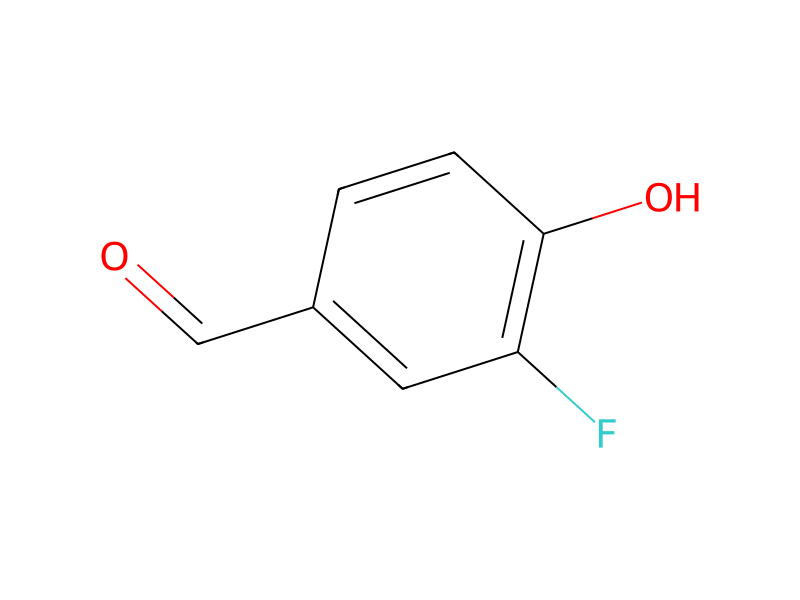



Procedure
A mixture of 3-fluoro-4-hydroxybenzaldehyde (4.264 g, 30.0 mmol), benzyl bromide (5.986 g, 35.0 mmol, 4.16 mL) and K2CO3 (820 g, 59.0 mmol) in DMF (50 mL) was stirred for 48 hours at room temperature before EtOAc (100 mL) and water (50 mL) were added. The organic layer was separated, washed with water (2×50 mL), brine (30 mL) and dried (Na2SO4). Concentration in vacuo gave a white solid residue. Recrystallization from CH2Cl2/n-hexane afforded CAB06038 as colorless needles (5.59 g, 81%). Mp. 94-95° C.; 1H NMR (400 MHz, CDCl3) δ 524 (s, 2H), 7.12 (dd, J=8.2, 8.2 Hz, 1H), 734-7.48 (m, 5H), 7.59-7.66 (m, 2H), 9.85 (d, J=2.0 Hz, 1H); LRMS (ES+): m/z 231.1 (100%, [M+H]+).
Workup
- additionwere added
- customThe organic layer was separated
- washwashed with water (2×50 mL), brine (30 mL)
- dry with materialdried (Na2SO4)
- concentrationConcentration in vacuo
- customgave a white solid residue
- customRecrystallization from CH2Cl2/n-hexane
Sources & evidence
- ORD record
- ord-3841b984b0134e28bf554ba3eafab8b1
- Source dataset
- uspto-grants-2014_09
- Patent number
- US08846737B2
Linked notes
Loading…