Reaction equation

Br[C:2]1[CH:23]=[CH:22][C:5]2[C:6]3[N:7]=[C:8]([N:14]4[C:18]([CH:19]5[CH2:21][CH2:20]5)=[CH:17][N:16]=[N:15]4)[S:9][C:10]=3[CH2:11][CH2:12][O:13][C:4]=2[CH:3]=1.Cl.N[OH:26].F[B-](F)(F)F.C(P(C(C)(C)C)C(C)(C)C)(C)(C)C.[N:45]12[CH2:55]CCN=C1CCCCC2.CCN(C(C)C)C(C)C>O1CCOCC1.C(OCC)(=O)C.CS(C)=O.O.[C-]#[O+].[C-]#[O+].[C-]#[O+].[C-]#[O+].[C-]#[O+].[C-]#[O+].[Mo].CC1C(P(C2C([CH2-])=CC=CC=2)C2C(C)=CC=CC=2)=CC=CC=1.CC1C(P(C2C([CH2-])=CC=CC=2)C2C(C)=CC=CC=2)=CC=CC=1.CC(O)=O.CC(O)=O.[Pd].[Pd]>[CH:19]1([C:18]2[N:14]([C:8]3[S:9][C:10]4[CH2:11][CH2:12][O:13][C:4]5[CH:3]=[C:2]([C:55]([NH2:45])=[O:26])[CH:23]=[CH:22][C:5]=5[C:6]=4[N:7]=3)[N:15]=[N:16][CH:17]=2)[CH2:21][CH2:20]1Participants
Reactant 5




Product 1

Reagents, catalysts & solvents 5





Conditions
- Temperature
- 150 °C
Procedure
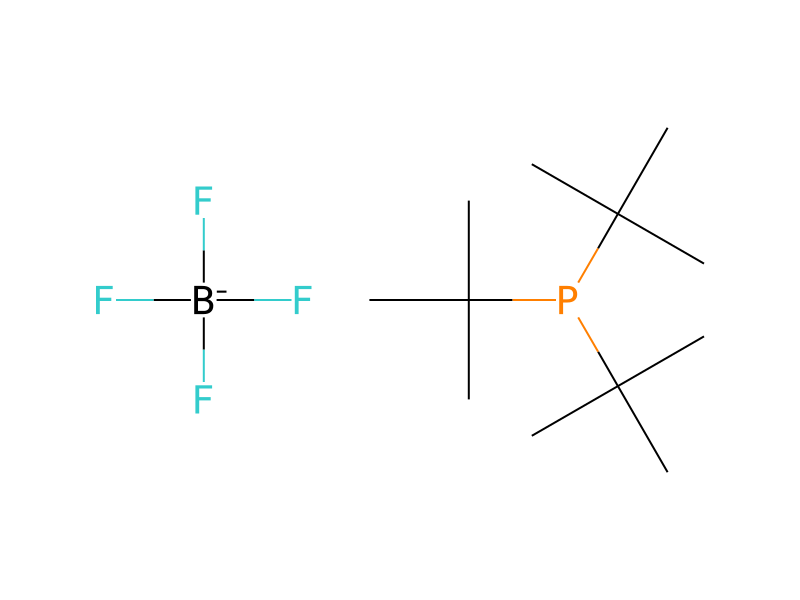
To a suspension of 8-bromo-2-(5-cyclopropyl-[1,2,3]triazol-1-yl)-4,5-dihydro-6-oxa-3-thia-1-aza-benzo[e]azulene (224 mg, 0.58 mmol), hydroxylamine hydrochloride (81 mg, 1.16 mmol), molybdenum hexacarbonyl (77 mg, 0.29 mmol), tri-tert-butylphosphine tetrafluoroborate (17 mg, 0.058 mmol), trans-di-μ-acetatobis[2-(di-o-tolylphosphino)benzyl]dipalladium(II) (27 mg, 0.029 mmol) in dioxane (7 mL) were added 1,8-diazabicyclo[5.4.0]undec-7-ene (86 μL, 0.58 mmol) and DIPEA (197 μL, 1.16 mmol). The reaction mixture was heated at 150° C. under microwave irradiation for 30 mins, and diluted with ethyl acetate. The organic layer was washed successively with water, aqueous saturated ammonium chloride, aqueous saturated sodium bicarbonate solution and brine, dried (Na2SO4) and concentrated in vacuo. The resultant residue was purified by flash chromatography (SiO2, 3% MeOH in DCM) to give an off-white solid, which was dissolved in DMSO/water. The mixture was left to stand at RT for 7 days, filtered, and the filtrate was diluted with ethyl acetate and water. The organic layer was washed with brine, dried (Na2SO4) and concentrated in vacuo to give 414 as an off-white solid (42 mg, 21%). LCMS (Method C): RT=8.65 min, [M+H]+=354. 1H NMR (DMSO-d6): 8.32 (1 H, d, J=8.3 Hz), 7.99 (1H, bs), 7.72 (1 H, d, J=0.7 Hz), 7.66 (1 H, dd, J=8.3, 1.8 Hz), 7.57 (1 H, d, J=1.8 Hz), 7.40 (1 H, bs), 4.41 (2 H, t, J=5.0 Hz), 3.45 (2 H, t, J=5.0 Hz), 2.74-2.66 (1 H, m), 1.23-1.15 (2 H, m), 0.93-0.87 (2 H, m).
Workup
- washThe organic layer was washed successively with water, aqueous saturated ammonium chloride, aqueous saturated sodium bicarbonate solution and brine
- dry with materialdried (Na2SO4)
- concentrationconcentrated in vacuo
- customThe resultant residue was purified by flash chromatography (SiO2, 3% MeOH in DCM)
- customto give an off-white solid, which
- waitThe mixture was left
- filtrationfiltered
- additionthe filtrate was diluted with ethyl acetate and water
- washThe organic layer was washed with brine
- dry with materialdried (Na2SO4)
- concentrationconcentrated in vacuo
Sources & evidence
- ORD record
- ord-975510443fa6406eb9d16d7e7ccdce26
- Source dataset
- uspto-grants-2014_09
- Patent number
- US08846762B2
Linked notes
Loading…