HomeMCPWorkbenchSkills
HomeWorkbenchNotificationsMe
llms.txt · MCP GuidePrivacy Policy · Terms of Service · Supportv1.8.0
  1. Home
  2. /Reaction

Dichloromethane → HCID 86700347, compound

HRID 879528
Notes
Print preview

Reaction equation

HRID 879528 reaction equation
Br[C:2]1[C:7]([CH:8]([F:10])[F:9])=[CH:6][N:5]=[C:4]([Cl:11])[CH:3]=1.B1(B2OC(C)(C)C(C)(C)O2)OC(C)(C)C(C)(C)O1.C(Cl)Cl.CC([O-])=O.[K+].Br[C:39]1[S:40][C:41]2[C:47]([C:48]3[CH:53]=[CH:52][C:51]([Cl:54])=[CH:50][CH:49]=3)=[C:46]([C@H:55]([O:61][C:62]([CH3:65])([CH3:64])[CH3:63])[C:56]([O:58][CH2:59][CH3:60])=[O:57])[C:45]([CH3:66])=[CH:44][C:42]=2[N:43]=1.C([O-])([O-])=O.[K+].[K+]>O1CCOCC1.CCOC(C)=O.C1C=CC(P(C2C=CC=CC=2)[C-]2C=CC=C2)=CC=1.C1C=CC(P(C2C=CC=CC=2)[C-]2C=CC=C2)=CC=1.Cl[Pd]Cl.[Fe+2]>[C:62]([O:61][C@@H:55]([C:46]1[C:45]([CH3:66])=[CH:44][C:42]2[N:43]=[C:39]([C:2]3[C:7]([CH:8]([F:10])[F:9])=[CH:6][N:5]=[C:4]([Cl:11])[CH:3]=3)[S:40][C:41]=2[C:47]=1[C:48]1[CH:49]=[CH:50][C:51]([Cl:54])=[CH:52][CH:53]=1)[C:56]([O:58][CH2:59][CH3:60])=[O:57])([CH3:63])([CH3:64])[CH3:65]
ParticipantsConditionsProcedureWorkupSources & evidenceReaction notes

Participants

10

Reactant 6

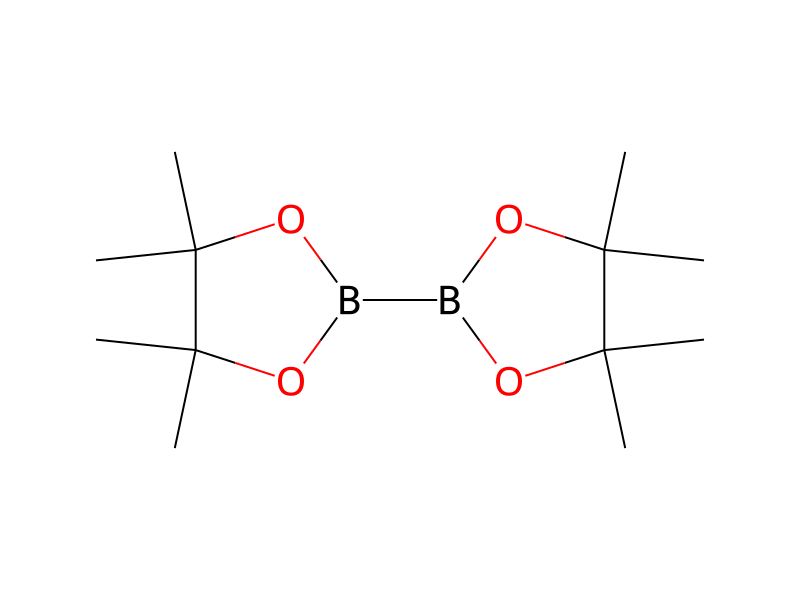
HCID 6344Dichloromethane2×HCID 11430Potassium CarbonateHCID 517044Potassium AcetateHCID 2733548Bis(pinacolato)diboraneHCID 86700141(S)-ethyl 2-(2-bromo-7-(4-chlorophenyl)-5-methylbenzo[d]thiazol-6-yl)-2-tert-butoxyacetateHCID 867003484-Bromo-2-chloro-5-(difluoromethyl)pyridine

Product 1

HCID 86700347HCID 86700347, compound

Reagents, catalysts & solvents 3

HCID 44119782Bis(cyclopenta-1,4-dien-1-yl(diphenyl)phosphane);dichloropalladium;iron(2+)Catalyst2×HCID 8857Ethyl AcetateSolventHCID 312751,4-DioxaneSolvent

Conditions

Temperature
100 °C

Procedure

A microwave vial was charged with 4-bromo-2-chloro-5-(difluoromethyl)pyridine (155 mg, 0.64 mmol), Bis(pinacolato)diboron (179 mg, 0.70 mmol), PdCl2(dppf).CH2Cl2 (55 mg, 0.07 mmol), then KOAc (198 mg, 2.00 mmol). The vial was flushed with argon, diluted with dioxane (4 mL), sealed, then heated to 100° C. for 1 hour. The reaction mixture was allowed to cool to room temperature and then a portion of this cooled solution (1.2 mL, 0.19 mmol) was added to a vial that was charged with (S)-ethyl 2-(2-bromo-7-(4-chlorophenyl)-5-methylbenzo[d]thiazol-6-yl)-2-tert-butoxyacetate (58 mg, 0.12 mmol) and PdCl2(dppf).CH2Cl2 (19 mg, 0.02 mmol). The mixture was diluted with dioxane (0.8 mL) and to this was added 2M aqueous K2CO3 (0.20 mL, 0.40 mmol). The vial was sealed, heated to 100° C. for 1 hour, and then allowed to cool to room temperature. The mixture was diluted with EtOAc, dried over Na2SO4, filtered, and concentrated in vacuo. The crude residue was purified by silica gel column chromatography (0-15% EtOAc/Hex gradient) to afford the desired product. LCMS-ESI+: calc'd C28H27Cl2F2N2O3S: 579.1 (M+H+); Found: 579.1 (M+H+).

Workup

  1. customThe vial was flushed with argon
  2. additiondiluted with dioxane (4 mL)
  3. customsealed
  4. temperatureto cool to room temperature
  5. customThe vial was sealed
  6. temperatureheated to 100° C. for 1 hour
  7. temperatureto cool to room temperature
  8. dry with materialdried over Na2SO4
  9. filtrationfiltered
  10. concentrationconcentrated in vacuo
  11. customThe crude residue was purified by silica gel column chromatography (0-15% EtOAc/Hex gradient)

Sources & evidence

ORD record
ord-180dd6e65b3442c69aecc7f4da17340f
Source dataset
uspto-grants-2015_03
DOI
10.6084/m9.figshare.5104873.v1
Patent number
US08987250B2

Reaction notes

Loading…

On this pageParticipantsConditionsProcedureWorkupSources & evidenceReaction notes