HomeMCPWorkbenchSkills
HomeWorkbenchNotificationsMe
llms.txt · MCP GuidePrivacy Policy · Terms of Service · Supportv1.8.3
  1. Home
  2. /Reaction

Tetrahydrofuran → ethyl 4-phenyl-7H-pyrrolo[2,3-d]pyrimidine-5-carboxylate

HRID 882112
Print

Reaction equation

HRID 882112 reaction equation
Cl[C:2]1[C:3]2[C:10]([C:11]([O:13][CH2:14][CH3:15])=[O:12])=[CH:9][NH:8][C:4]=2[N:5]=[CH:6][N:7]=1.[C:16]1(B(O)O)[CH:21]=[CH:20][CH:19]=[CH:18][CH:17]=1.C(=O)([O-])[O-].[K+].[K+].O1CCCC1>CCOC(C)=O.C1C=CC(P(C2C=CC=CC=2)[C-]2C=CC=C2)=CC=1.C1C=CC(P(C2C=CC=CC=2)[C-]2C=CC=C2)=CC=1.Cl[Pd]Cl.[Fe+2].C(Cl)Cl>[C:16]1([C:2]2[C:3]3[C:10]([C:11]([O:13][CH2:14][CH3:15])=[O:12])=[CH:9][NH:8][C:4]=3[N:5]=[CH:6][N:7]=2)[CH:21]=[CH:20][CH:19]=[CH:18][CH:17]=1
ParticipantsConditionsProcedureWorkupSources & evidenceReaction notes

Participants

7

Reactant 4

HCID 8028TetrahydrofuranHCID 11430Potassium CarbonateHCID 66827Phenylboronic AcidHCID 105611797H-Pyrrolo(2,3-d)pyrimidine-5-carboxylic acid, 4-chloro-, ethyl ester

Product 1

HCID 71599593ethyl 4-phenyl-7H-pyrrolo[2,3-d]pyrimidine-5-carboxylate

Reagents, catalysts & solvents 2

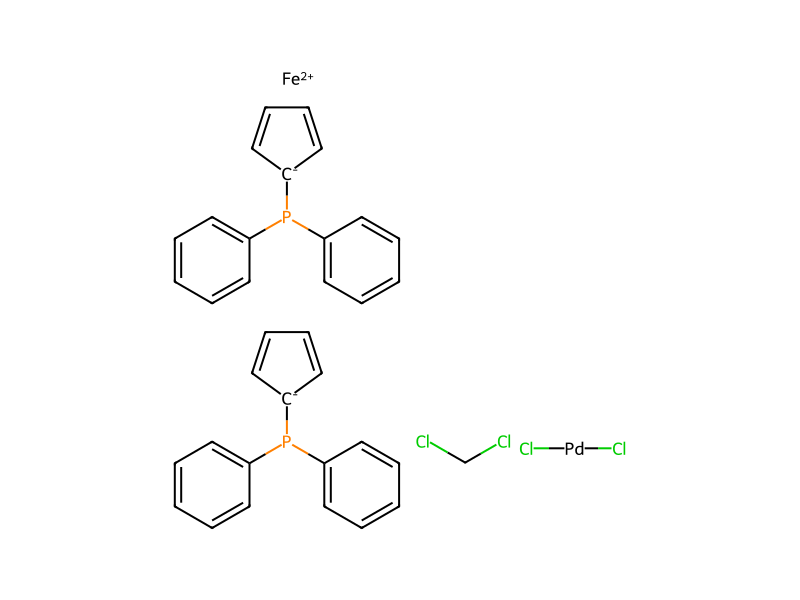
HCID 178418807
HCID 178418807, compound
Catalyst
HCID 8857Ethyl AcetateSolvent

Conditions

Temperature
125 °C

Procedure

Ethyl 4-chloro-7H-pyrrolo[2,3-d]pyrimidine-5-carboxylate (50.0 mg, 0.222 mmol), phenyl boronic acid (32.4 mg, 0.266 mmol) and potassium carbonate (0.332 mL, 0.665 mmol) were added to tetrahydrofuran (1.5 mL) in a microwave vial. The solution was purged with nitrogen for 5 minutes and PdCl2(dppf)-CH2Cl2 (18 mg, 0.022 mmol) was then added. The reaction was sealed and heated at 125° C. by microwave irradiation for 30 minutes. The reaction mixture was diluted with EtOAc and washed with saturated sodium bicarbonate, dried over sodium sulfate, filtered and concentrated under reduced pressure. Purification of desired product was carried out by reverse phase HPLC using an acetonitrile gradient in water with 0.1% TFA modifier. Pure fractions were pooled and concentrated under reduced pressure. Saturated aqueous sodium bicarbonate and EtOAc were added to the residue. The organic layer was separated and the aqueous layer was then extracted with EtOAc (×3). The combined organic layers were then washed with brine, dried over sodium sulfate, filtered and concentrated under reduced pressure to afford the product as a solid. LRMS (ESI) calc'd for C15H14ClN3O2 [M+H]+: 268, found 268. 1H NMR (600 MHz, DMSO-D6) δ 13.01 (s, 1H), 8.91 (s, 1H), 8.30 (s, 1H), 7.63 (m, 2H), 7.49 (m, 3H), 3.82 (q, 2H, J=7.04 Hz), 0.78 (t, 3H, J=7.04 Hz).


Workup

  1. customThe solution was purged with nitrogen for 5 minutes
  2. customThe reaction was sealed
  3. washwashed with saturated sodium bicarbonate
  4. dry with materialdried over sodium sulfate
  5. filtrationfiltered
  6. concentrationconcentrated under reduced pressure
  7. customPurification of desired product
  8. concentrationconcentrated under reduced pressure
  9. additionSaturated aqueous sodium bicarbonate and EtOAc were added to the residue
  10. customThe organic layer was separated
  11. extractionthe aqueous layer was then extracted with EtOAc (×3)
  12. washThe combined organic layers were then washed with brine
  13. dry with materialdried over sodium sulfate
  14. filtrationfiltered
  15. concentrationconcentrated under reduced pressure

Sources & evidence

ORD record
ord-98c6040c16bf4601a7c44abf2ce35a95
Source dataset
uspto-grants-2015_03
DOI
10.6084/m9.figshare.5104873.v1
Patent number
US08993756B2

Reaction notes

On this pageParticipantsConditionsProcedureWorkupSources & evidenceReaction notes