Reaction equation
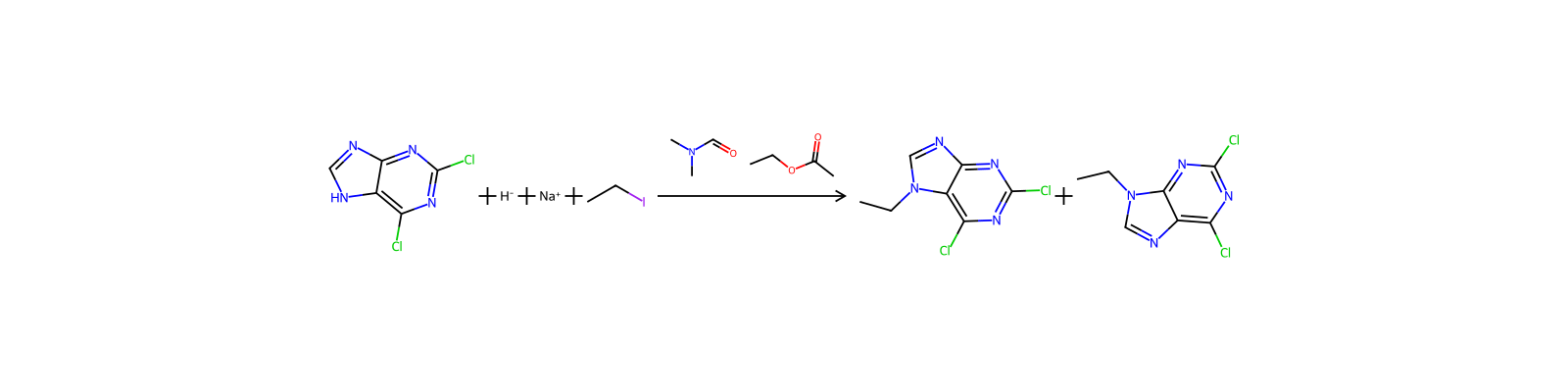
[Cl:1][C:2]1[N:10]=[C:9]2[C:5]([NH:6][CH:7]=[N:8]2)=[C:4]([Cl:11])[N:3]=1.[H-].[Na+].[CH2:14](I)[CH3:15]>CN(C=O)C.C(OCC)(=O)C>[Cl:1][C:2]1[N:10]=[C:9]2[C:5]([N:6]([CH2:14][CH3:15])[CH:7]=[N:8]2)=[C:4]([Cl:11])[N:3]=1.[Cl:1][C:2]1[N:10]=[C:9]2[C:5]([N:6]=[CH:7][N:8]2[CH2:14][CH3:15])=[C:4]([Cl:11])[N:3]=1Participants
7






Procedure
1.0 g (5.29 mmol) of 2,6-dichloro-purine is dissolved in DMF (20 ml) and treated with 152 mg (80%, 5.3 mmol) of sodium hydride and the mixture is stirred at RT for 0.5 hours. After addition of 0.42 ml (5.3 mmol) of ethyl iodide, the mixture is stirred at 70° C. for 3 hours, diluted with ethyl acetate (100 ml) and extracted with concentrated brine. The organic phase is dried (sodium sulfate) and concentrated and the residue is chromatographed (silica gel, methylene chloride:methanol=19:1). An oily mixture comprising 2,6-dichloro-7-ethyl-7H-purine and 2,6-dichloro-9-ethyl-9H-purine is obtained.
Workup
- stirringthe mixture is stirred at 70° C. for 3 hours
- extractionextracted with concentrated brine
- dry with materialThe organic phase is dried (sodium sulfate)
- concentrationconcentrated
- customthe residue is chromatographed (silica gel, methylene chloride:methanol=19:1)
Sources & evidence
- ORD record
- ord-66d3e0ffc92349d497cdf78b8c94e762
- Source dataset
- uspto-grants-2006_08
- Patent number
- US07091346B1
Linked notes
Loading…