
Ibuprofen, Sodium Salt
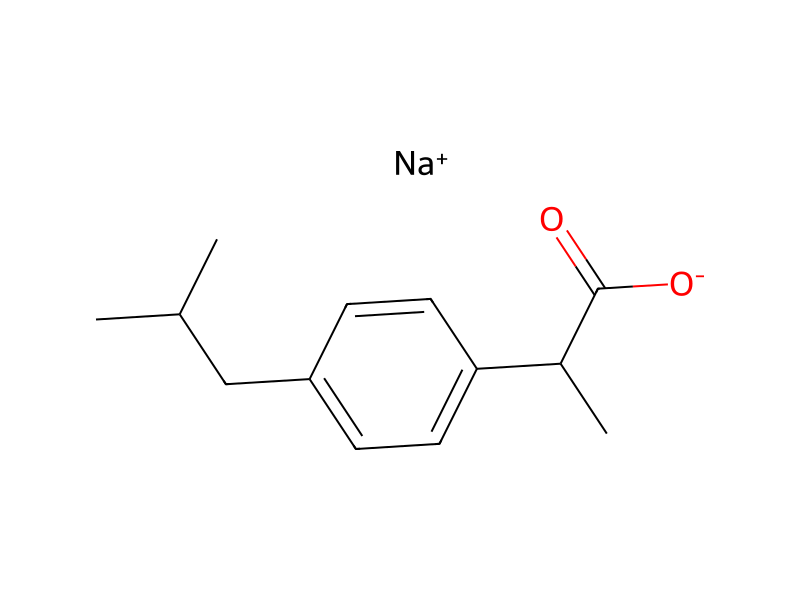
기본 정보
- CAS
31121-93-4- 표준 SMILES
CC(C)Cc1ccc(C(C)C(=O)[O-])cc1.[Na+]- InChIKey
PTTPUWGBPLLBKW-UHFFFAOYSA-M- 분자식
- C13H17NaO2
- 평균 분자량
- 228.26 g/mol
- 단동위원소 질량
- 228.11262406
이름 및 식별자
- 우선 이름
- Ibuprofen, Sodium Salt
- IUPAC
- sodium 2-[4-(2-methylpropyl)phenyl]propanoate
- 영어명
- IBUPROFEN SODIUM SALT
- 분자식
- C13H17NaO2
- 분자량
- 228.26
이름 및 동의어
Ibuprofen, Sodium SaltRefChem:5538631121-93-4Ibuprofen sodium saltSodium ibuprofenSodium 2-(4-isobutylphenyl)propanoateSodium 2-(4-isobutylphenyl)propionateIbuprofen sodium anhydrousEINECS 250-477-6p-Isobutylhydratropic acid sodium saltsodium 2-[4-(2-methylpropyl)phenyl]propanoateIbuprofen (sodium)
이름 더 보기
ibuprofensodium(±)-Ibuprofen-d3, SodiuM Salt(±)-Ibuprofen-d3 (sodium salt)p-isobutylhydratropicacidsodiumsaltp-isobutyl-hydratropicacisodiumsalt
sodium;2-[4-(2-methylpropyl)phenyl]propanoateO0PJ4UZ01UHydratropic acid, p-isobutyl-, sodium saltBenzeneacetic acid, alpha-methyl-4-(2-methylpropyl)-, sodium saltMFCD00133414AKOS0159946272-(p-isobutylphenyl)propionic acid sodium saltC13H17NaO2
데이터베이스 식별자
- CAS
31121-93-4- PubChem CID
- 5338317
- DTXSID
DTXSID4040501- ChEMBL
CHEMBL1241153- UNII
- O0PJ4UZ01U
- EC Number
- 250-477-6
- Nikkaji
- J27.647B
물성
구조 계산 물성
- 극성 표면적
- 40.1 Ų
- 수소 결합 공여자 수
- 0
- 수소 결합 수용자 수
- 2
- 회전 가능 결합 수
- 4
- 무거운 원자 수
- 16
- 형식 전하
- 0
- 복잡도
- 208
물리화학적 성질
- 녹는점
- 110 · 110-112 °C
- 저장 조건
- -20 °C · Hygroscopic, -20°C Freezer, Under inert atmosphere
- 용해도
- 2 O: · H2O: 100 mg/mL, 투명하거나 약간 흐릿할 수 있음
- 물리적 상태
- Solid
- 색상
- 흰색에서 황백색까지
- 수용성
- 2 O: · H2O: 100mg/mL, clear to slightly hazy
- 안정성
- 안정적인. 강한 산화제와 호환되지 않습니다.
- 주요 응용
- 법의학 및 독성학의약품(소분자)
- InChI
- 1S/C13H18O2.Na/c1-9(2)8-11-4-6-12(7-5-11)10(3)13(14)15;/h4-7,9-10H,8H2,1-3H3,(H,14,15);/q;+1/p-1
- InChIKey
- PTTPUWGBPLLBKW-UHFFFAOYSA-M
- SMILES
- [Na+].CC(C)Cc1ccc(cc1)C(C)C([O-])=O
화학적 성질
white powder
안전 및 규제
안전 정보는 참고용이며, 공급업체의 물질안전보건자료(SDS), 관련 법규 및 전문가 평가를 대체하지 않습니다.
GHS 분류
GHS Classification
This chemical does not meet GHS hazard criteria for 1% (2 of 210) of reports.
Danger
H302 (99%): Harmful if swallowed [Warning Acute toxicity, oral]
P203, P261, P264, P264+P265, P270, P271, P280, P301+P317, P302+P352, P304+P340, P305+P351+P338, P305+P354+P338, P317, P318, P319, P321, P330, P337+P317, P362+P364, P403+P233, P405, and P501 (click each P-code to see the statement)
Aggregated GHS information provided per 210 reports by companies from 5 notifications to the ECHA C&L Inventory. Each notification may be associated with multiple companies.
유해성 정보
Other Safety InformationIMAP assessments - Benzeneacetic acid, .alpha.-methyl-4-(2-methylpropyl)-, sodium salt: Environment tier I assessment
Hazard Classes and CategoriesAcute Tox. 4 (99%)
안전 데이터
- wgk
- 3
- rtecs
- MU6641000
- safety_code
- 22-24/25
- 스토리지 클래스
- 11 - Combustible Solids
화학 및 산업
약리 정보
MeSH Pharmacological Classification
Anti-inflammatory agents that are non-steroidal in nature. In addition to anti-inflammatory actions, they have analgesic, antipyretic, and platelet-inhibitory actions. They act by blocking the synthesis of prostaglandins by inhibiting cyclooxygenase, which converts arachidonic acid to cyclic endoperoxides, precursors of prostaglandins. Inhibition of prostaglandin synthesis accounts for their analgesic, antipyretic, and platelet-inhibitory actions; other mechanisms may contribute to their anti-inflammatory effects.
Compounds or agents that combine with cyclooxygenase (PROSTAGLANDIN-ENDOPEROXIDE SYNTHASES) and thereby prevent its substrate-enzyme combination with arachidonic acid and the formation of eicosanoids, prostaglandins, and thromboxanes.
A subclass of analgesic agents that typically do not bind to OPIOID RECEPTORS and are not addictive. Many non-narcotic analgesics are offered as NONPRESCRIPTION DRUGS.
상·하류 제품 정보
하류 제품
관련 반응
9건


화합물 노트
불러오는 중…