Lithium Hydroxide → HCID 89784159, compound
Reaction equation

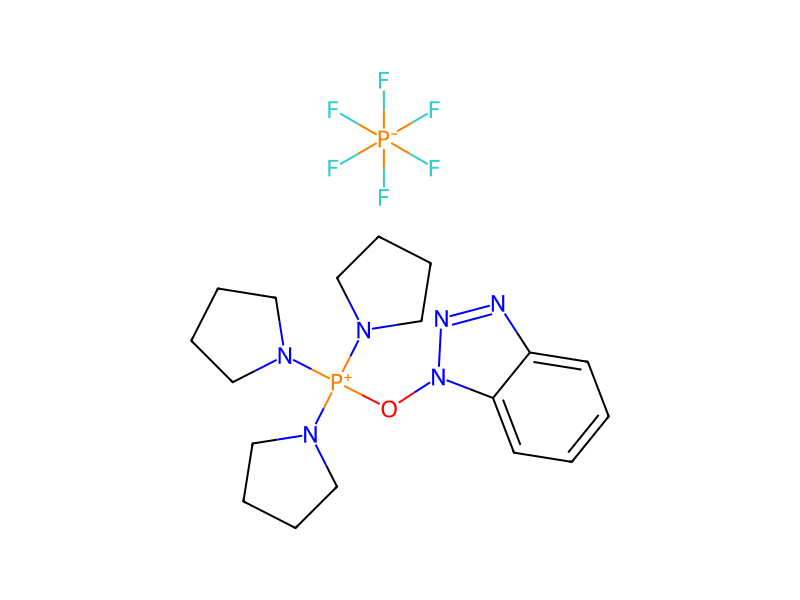
[CH:1]1([NH:4][C:5]2[C:6]([CH3:45])=[N:7][C:8]3[C:13]([N:14]=2)=[C:12]([C:15]2[NH:19][C:18]([C@H:20]([NH:31][C:32](=[O:38])OC(C)(C)C)[C@H:21]([CH3:30])[O:22][Si](C)(C)C(C)(C)C)=[C:17](C(OCC)=O)[CH:16]=2)[C:11]([F:44])=[CH:10][CH:9]=3)[CH2:3][CH2:2]1.[Li+].[OH-].C1CN([P+](ON2N=NC3C=CC=CC2=3)(N2CCCC2)N2CCCC2)CC1.F[P-](F)(F)(F)(F)F>O1CCOCC1.Cl.CN(C=O)C>[CH:1]1([NH:4][C:5]2[C:6]([CH3:45])=[N:7][C:8]3[C:13]([N:14]=2)=[C:12]([C:15]2[NH:19][C:18]4[C@@H:20]([C@@H:21]([OH:22])[CH3:30])[NH:31][C:32](=[O:38])[C:17]=4[CH:16]=2)[C:11]([F:44])=[CH:10][CH:9]=3)[CH2:2][CH2:3]1Participants






Procedure
A solution of ethyl 5-(3-(cyclopropylamino)-6-fluoro-2-methylquinoxalin-5-yl)-2-((5S,6S)-2,2,3,3,5,10,10-heptamethyl-8-oxo-4,9-dioxa-7-aza-3-silaundecan-6-yl)-1H-pyrrole-3-carboxylate (353b) (2.43 g, 3.79 mmol) in 1,4-dioxane (40 mL) was treated with 1.0 M aq. LiOH (19 mL, 19 mmol). The resulting orange solution was stirred at RT for 16 h. The mixture was then heated at 85° C. for 6 h, and then at 65° C. for 64 h. The resulting suspension was concentrated to give a dark solid. Then solid was dissolved in a 4.0 M solution of HCl in 1,4-dioxane (20 mL). The resulting dark red solution was stirred at RT for 45 min. The mixture was concentrated and the dark red residue containing 354c was dissolved in a mixture of 1,4-dioxane (20 mL) and water (10 mL). TEA (1.2 mL, 8 mmol) was added and the mixture was lyophilized to give a brown solid. A solution of the brown solid in DMF (40 mL) was treated with TEA (2.64 mL, 18.94 mmol) followed by PyBOP (NovaBiochem) (3.94 g, 7.57 mmol). The mixture was stirred at RT for 1 h. The mixture was concentrated and water (100 mL) was added. A brown gum separated out. The mixture was stirred and heated at 100° C. for 1 h, and then cooled in an ice-water bath. Saturated aq. NaHCO3 (5 mL) was added and the mixture was stirred for 15 min. The aq. layer was decanted from the flask (product adhered to the sides of the vessel), and the product was washed with water (10 mL). The product was dissolved in 1,4-dioxane (25 mL), filtered, and concentrated. The resulting gum was dissolved in DMSO (10 mL) and purified by preparative HPLC (Gradient: 10-100% MeCN in H2O, modified with 0.1% TFA). The major product was concentrated, neutralized with 2 M NH3 in MeOH, and lyophilized from 1,4-dioxane to give (S)-2-(3-(cyclopropylamino)-6-fluoro-2-methylquinoxalin-5-yl)-6-((S)-1-hydroxyethyl)-5,6-dihydropyrrolo[3,4-b]pyrrol-4(1H)-one (353) (342 mg) as a yellow solid. LC-MS m/z 382.0, [M+H]+; 19F NMR (DMSO-d6; 376 MHz): δ −108.03 (s, 1F). A slower eluting minor product was also isolated from the preparative HPLC. This product was concentrated, neutralized with 2 M NH3 in MeOH, and lyophilized from 1,4-dioxane to give (R)-2-(3-(cyclopropylamino)-6-fluoro-2-methylquinoxalin-5-yl)-6-((S)-1-hydroxyethyl)-5,6-dihydropyrrolo[3,4-b]pyrrol-4(1H)-one (354) (29 mg) as a yellow solid. LC-MS m/z 382.0, [M+H]+; 19F NMR (DMSO-d6; 376 MHz): δ −108.79 (s, 1F).
Workup
- temperatureThe mixture was then heated at 85° C. for 6 h
- waitat 65° C. for 64 h
- concentrationThe resulting suspension was concentrated
- customto give a dark solid
- stirringThe resulting dark red solution was stirred at RT for 45 min
- concentrationThe mixture was concentrated
- additionthe dark red residue containing 354c
- dissolutionwas dissolved in a mixture of 1,4-dioxane (20 mL) and water (10 mL)
- customto give a brown solid
- stirringThe mixture was stirred at RT for 1 h
- concentrationThe mixture was concentrated
- additionwater (100 mL) was added
- customA brown gum separated out
- stirringThe mixture was stirred
- temperatureheated at 100° C. for 1 h
- temperaturecooled in an ice-water bath
- additionSaturated aq. NaHCO3 (5 mL) was added
- stirringthe mixture was stirred for 15 min
- customThe aq. layer was decanted from the flask (product
- washwas washed with water (10 mL)
- dissolutionThe product was dissolved in 1,4-dioxane (25 mL)
- filtrationfiltered
- concentrationconcentrated
- dissolutionThe resulting gum was dissolved in DMSO (10 mL)
- custompurified by preparative HPLC (Gradient: 10-100% MeCN in H2O, modified with 0.1% TFA)
- concentrationThe major product was concentrated
Sources & evidence
- ORD record
- ord-e601bf999fec428a80e009ec34b51268
- Source dataset
- uspto-grants-2016_07
- Patent number
- US09394297B2
Reaction notes
Loading…