Hydrochloric Acid → Thiophene, 2,5-dibromo-3-hexyl-
Reaction equation

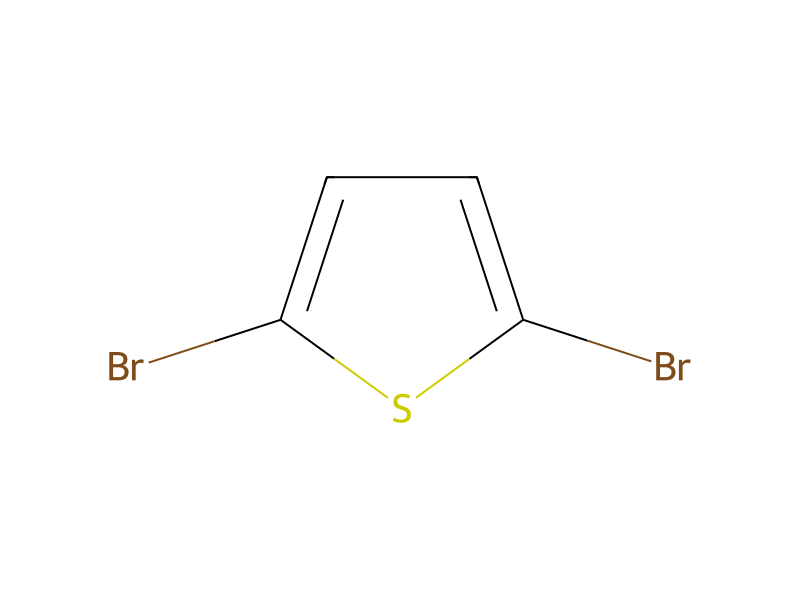
[Mg].Br[CH:3]([CH3:5])[CH3:4].[Br:6][C:7]1[S:8][C:9]([Br:12])=[CH:10][CH:11]=1.Cl.[CH2:14]1[CH2:18]OC[CH2:15]1>>[Br:6][C:7]1[S:8][C:9]([Br:12])=[CH:10][C:11]=1[CH2:4][CH2:3][CH2:5][CH2:15][CH2:14][CH3:18]Participants





Procedure
To a dry 3-necked flask under nitrogen is added magnesium filings (354 mg, 14.6 mmol). A solution of 2,5-dibromo-3-hexylthiophene (4.41 g, 13.5 mmol) in anhydrous THF (45 ml) is prepared and 5 ml of this solution is added to the magnesium at 5° C. The reaction is initated by the addition of 2-bromopropane (80 mg, 0.65 mmol). After 5 min, the remaining solution of 2,5-dibromothiophene is added dropwise, keeping the temperature below 10° C. The resulting yellow solution is warmed to room temperature and stirred for 4 h at that temperature. An aliquot is taken, hydrolysed with dilute hydrochloric acid and analysed by GCMS to reveal 98% formation of monogrignard reagent and 2% formation of a digrignard reagent. No starting material remained. The solution is transferred, via cannula, to a new reaction vessel and heated to reflux. 1,2-bis{diphenylphosphinopropane)dichloronickel (II) (72 mg, 1 mol %) is added as a solid and the reaction refluxed for 4 h. The reaction is cooled to room temperature and precipitated into methanol. The resulting polymer is filtered, and washed with additional methanol (soxhlet) and heptane (soxhlet). The resulting polymer is dissolved in chloroform and precipitated into methanol to afford 0.6 g of polymer.
Workup
- customthe temperature below 10° C
- customThe solution is transferred, via cannula, to a new reaction vessel
- temperatureheated to reflux
- temperaturethe reaction refluxed for 4 h
- temperatureThe reaction is cooled to room temperature
- customprecipitated into methanol
- filtrationThe resulting polymer is filtered
- washwashed with additional methanol (soxhlet) and heptane (soxhlet)
- dissolutionThe resulting polymer is dissolved in chloroform
- customprecipitated into methanol
Sources & evidence
- ORD record
- ord-53abecae82894695818a1a5f8f124803
- Source dataset
- uspto-grants-2010_10
- Patent number
- US07807776B2
Reaction notes
Loading…