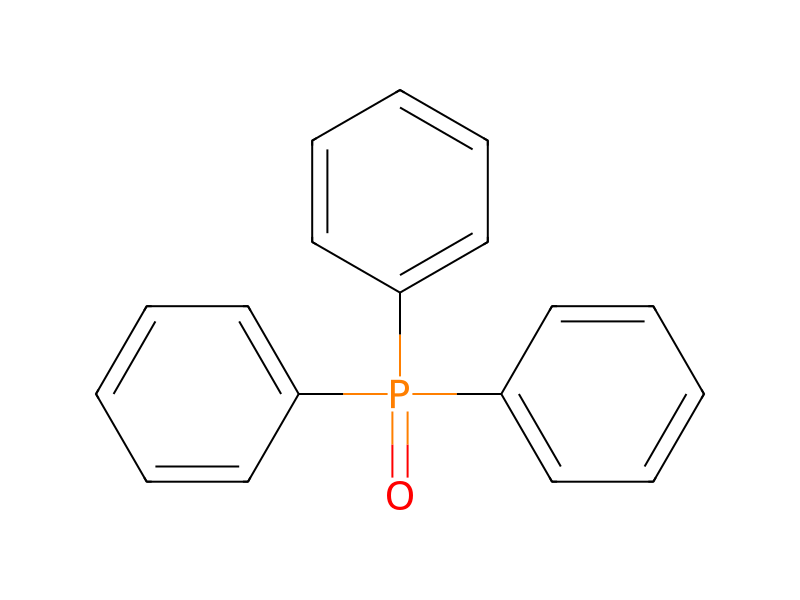
N-Hydroxyphthalimide → Triphenylphosphine Oxide
Reaction equation

CC[O:3]C(/N=N/C(OCC)=O)=O.C(OC(=O)CCCCCCCCCCCO)C1C=CC=CC=1.[C:35]1([P:41]([C:48]2[CH:53]=[CH:52][CH:51]=[CH:50][CH:49]=2)[C:42]2[CH:47]=[CH:46][CH:45]=[CH:44][CH:43]=2)[CH:40]=[CH:39][CH:38]=[CH:37][CH:36]=1.ON1C(=O)C2=CC=CC=C2C1=O>C1COCC1.CCCCCC.C(OC(=O)C)C>[C:48]1([P:41](=[O:3])([C:35]2[CH:36]=[CH:37][CH:38]=[CH:39][CH:40]=2)[C:42]2[CH:47]=[CH:46][CH:45]=[CH:44][CH:43]=2)[CH:49]=[CH:50][CH:51]=[CH:52][CH:53]=1Participants
Reactant 4




Product 1
Reagents, catalysts & solvents 2


Procedure
Diethylazodicarboxylate (DEAD, 16.96 ml, 107.7 mmol) was added dropwise to the mixture of 12-Hydroxydodecanoic acid benzyl ester (21 g, 71.8 mmol), triphenylphosphine (28.29 g, 107.7 mmol) and N-hydroxyphthalimide (12.88 g, 78.98 mmol) in absolute THF (250 ml) at −20°-−30° C. under stirring. The reaction mixture was stirred at this temperature for additional 2-3 h, after which time TLC (hexane-ethylacetate 3:1) indicated reaction completion. The solvent was removed in vacuo and the residue was treated ether (250 ml). Formed precipitate of triphenylphosphine oxide was filtered off, mother liquor was evaporated to dryness and the residue was dissolved in methylene chloride and purified by flash chromatography on silica gel in hexane-ethyl acetate (7:3). Appropriate fractions were pooled and evaporated to dryness to afford 26.5 g (84.4%) of compound 15.
Workup
- stirringThe reaction mixture was stirred at this temperature for additional 2-3 h
- customreaction completion
- customThe solvent was removed in vacuo
- additionthe residue was treated ether (250 ml)
Sources & evidence
- ORD record
- ord-c14fee49e0b14b92af72a16dd5b0381a
- Source dataset
- uspto-grants-2010_11
- Patent number
- US07833992B2
Reaction notes
Loading…