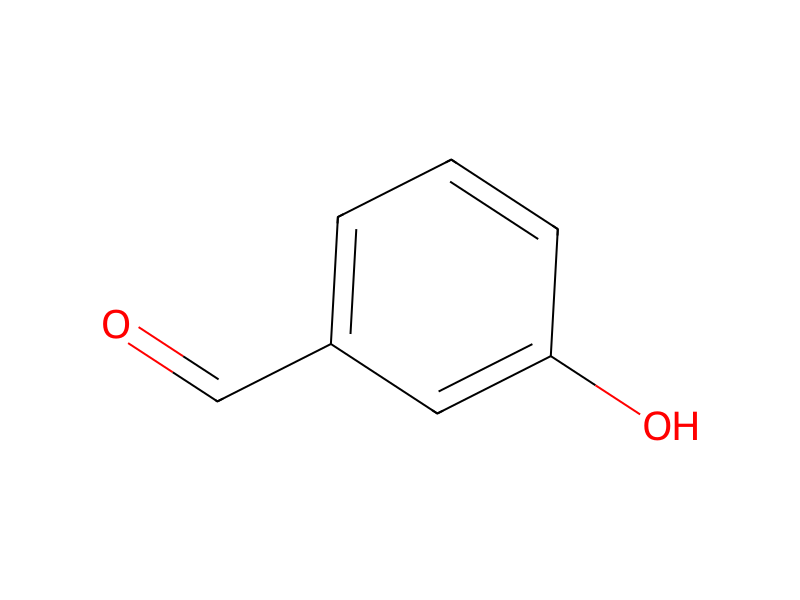
3-Hydroxybenzaldehyde → HCID 21071511, compound
Reaction equation

Br[CH2:2][CH2:3][CH2:4][F:5].[OH:6][C:7]1[CH:8]=[C:9]([CH:12]=[CH:13][CH:14]=1)[CH:10]=[O:11].C(=O)([O-])[O-].[K+].[K+].ClCCl>CN(C)C=O.C(OCC)(=O)C>[F:5][CH2:4][CH2:3][CH2:2][O:6][C:7]1[CH:8]=[C:9]([CH:12]=[CH:13][CH:14]=1)[CH:10]=[O:11]Participants






Conditions
- Temperature
- 100 °C
Procedure
Combine 1-bromo-3-fluoropropane (10.0 g, 77.1 mmol) and 3-hydroxybenzaldehyde (10.4 g, 92.5 mmol) in dimethylformamide (220 mL) and stir at room temperature. Treat with potassium carbonate in portions (21.3 g, 144.2 mmol). Heat the reaction mixture at 100° C. for 36 hours, then pour into a 1:1 mixture of ice water and dichloromethane. Separate the phases and extract the aqueous layer with additional dichloromethane. Wash the combined organic extracts sequentially with 1.0 N sodium hydroxide, saturated sodium bicarbonate, brine, and then dry over sodium sulfate. Filtration and removal of the solvent in vacuo provides a residue. Chromatograph the residue on silica gel eluting with 40% ethyl acetate in hexanes to give the title compound as a yellow oil: 1H NMR (400 MHz, CDCl3) 9.98 (s, 1H), 7.50–7.42 (m, 2H), 7.42–7.38 (m, 1H), 7.22–7.16 (m, 1H), 4.66 (dt, 2H, J=46.8, 5.8 Hz), 4.17 (t, 2H, J=6.0 Hz), 2.19 (d quintuplets, 2H, J=26.0, 6.0 Hz); MS (APCI): m/e 183.1 (M+1).
Workup
- customSeparate the phases
- extractionextract the aqueous layer with additional dichloromethane
- washWash the combined organic extracts sequentially with 1.0 N sodium hydroxide, saturated sodium bicarbonate, brine
- dry with materialdry over sodium sulfate
- filtrationFiltration and removal of the solvent in vacuo
- customprovides a residue
Sources & evidence
- ORD record
- ord-dd584bfc222a4a51bfe04e4c0577746c
- Source dataset
- uspto-grants-2007_01
- Patent number
- US07157488B2
Reaction notes
Loading…