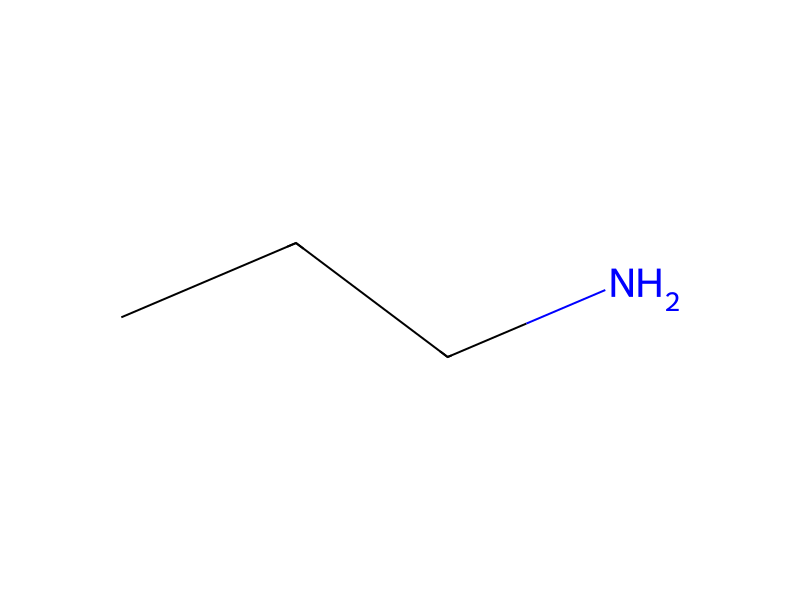
Propylamine → N-[2-Chloro-4-[(6,7-dimethoxy-4-quinolinyl)oxy]phenyl]-N′-propylurea
Reaction equation

[Cl:1][C:2]1[CH:8]=[C:7]([O:9][C:10]2[C:19]3[C:14](=[CH:15][C:16]([O:22][CH3:23])=[C:17]([O:20][CH3:21])[CH:18]=3)[N:13]=[CH:12][CH:11]=2)[CH:6]=[CH:5][C:3]=1[NH2:4].ClC(Cl)(O[C:28](=[O:34])OC(Cl)(Cl)Cl)Cl.[CH2:36]([NH2:39])[CH2:37][CH3:38].C(=O)([O-])O.[Na+]>C(Cl)(Cl)Cl.C(N(CC)CC)C>[Cl:1][C:2]1[CH:8]=[C:7]([O:9][C:10]2[C:19]3[C:14](=[CH:15][C:16]([O:22][CH3:23])=[C:17]([O:20][CH3:21])[CH:18]=3)[N:13]=[CH:12][CH:11]=2)[CH:6]=[CH:5][C:3]=1[NH:4][C:28]([NH:39][CH2:36][CH2:37][CH3:38])=[O:34]Participants
Reactant 4



Product 1

Reagents, catalysts & solvents 2


Procedure
2-Chloro-4-[(6,7-dimethoxy-4-quinolyl)oxy]aniline (100 mg) was dissolved in chloroform (7.5 ml) and triethylamine (1 ml), and a solution of triphosgene (99 mg) in chloroform was then added to the solution. The mixture was heated under reflux for 5 min. Next, n-propylamine (21 mg) was added to the reaction solution, and the mixture was heated under reflux for additional 2 hr. A saturated aqueous sodium hydrogencarbonate solution was added to the reaction solution, and the mixture was supported on diatomaceous earth, followed by extraction with chloroform. The solvent was removed by distillation under the reduced pressure. The residue was purified by chromatography on silica gel by development with chloroform/methanol (8/1). Thus, the title compound was quantitatively obtained.
Workup
- temperatureThe mixture was heated
- temperatureunder reflux for 5 min
- temperaturethe mixture was heated
- temperatureunder reflux for additional 2 hr
- extractionfollowed by extraction with chloroform
- customThe solvent was removed by distillation under the reduced pressure
- customThe residue was purified by chromatography on silica gel by development with chloroform/methanol (8/1)
Sources & evidence
- ORD record
- ord-5cf189d6783940918ba488cb5d0099ef
- Source dataset
- uspto-grants-2007_01
- Patent number
- US07169789B2
Reaction notes
Loading…