Hydrochloric Acid → Ethyl 2-(3-chlorophenoxy)acetate
Reaction equation
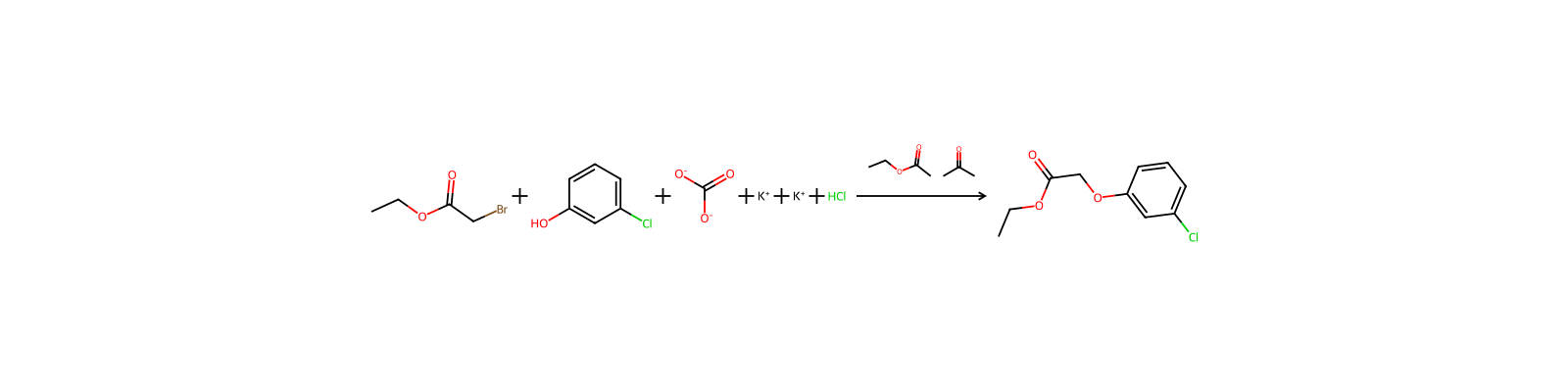
Br[CH2:2][C:3]([O:5][CH2:6][CH3:7])=[O:4].[Cl:8][C:9]1[CH:10]=[C:11]([OH:15])[CH:12]=[CH:13][CH:14]=1.C(=O)([O-])[O-].[K+].[K+].Cl>C(OCC)(=O)C.CC(C)=O>[CH2:6]([O:5][C:3](=[O:4])[CH2:2][O:15][C:11]1[CH:12]=[CH:13][CH:14]=[C:9]([Cl:8])[CH:10]=1)[CH3:7]Participants







Procedure
Acetone (320 ml), 75 g (450 mmol) of ethyl bromoacetate, and 40.0 g (310 mmol) of 3-chlorophenol were mixed together, then 69.8 g (505 mmol) of potassium carbonate was added. The mixture was mechanically stirred and heated to reflux for 4 h, and after cooling to room temperature, was poured into 350 mL of ethyl acetate. To this was then cautiously added 400 mL of 1M HCl, taking care to avoid excess foaming. The layers were separated and the aqueous layer was extracted with portions of ethyl acetate (3×200 mL). The combined organic layers were dried over MgSO4, filtered, concentrated, and the resulting solid was recrystallized from hexane to afford 58 g (87%) of 10 as a white solid, m.p.=39°-40° C. 1H NMR δ 7.20-7.08 (m, 1H), 6.95-6.82 (m, 2H), 6.75-6.70 (m, 1H), 4.53 (s, 2H), 4.21 (q, J=7.2 Hz, 2H), 1.23 (t, J=7.2 Hz, 3H).
Workup
- temperatureheated
- temperatureto reflux for 4 h
- customThe layers were separated
- extractionthe aqueous layer was extracted with portions of ethyl acetate (3×200 mL)
- dry with materialThe combined organic layers were dried over MgSO4
- filtrationfiltered
- concentrationconcentrated
- customthe resulting solid was recrystallized from hexane
Sources & evidence
- ORD record
- ord-ad2f4c03402d49fc982ffaecdb3548c7
- Source dataset
- uspto-grants-1997_09
- Patent number
- US05665773
Reaction notes
Loading…