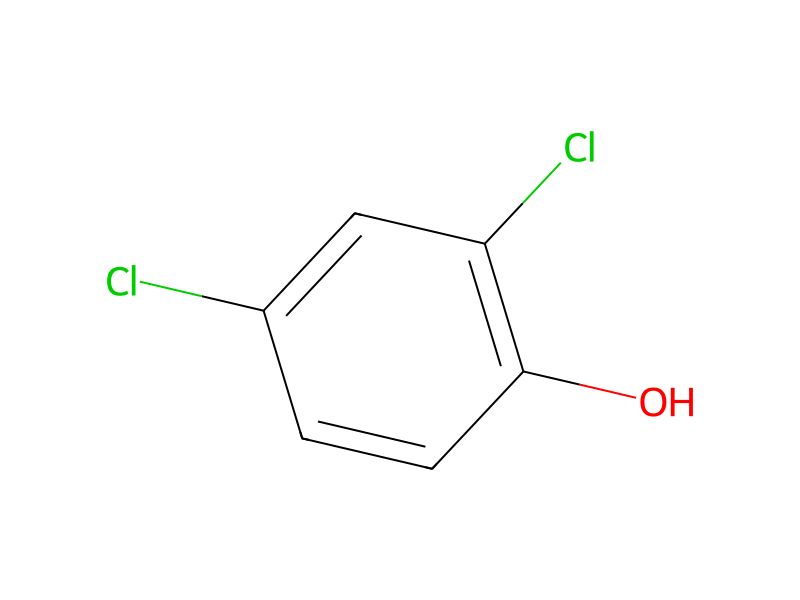
2,4-Dichlorophenol → ethyl (R)-2-(2,4-dichlorophenoxy)propionate
Reaction equation

[Cl:1][C:2]1[CH:7]=[C:6]([Cl:8])[CH:5]=[CH:4][C:3]=1[OH:9].[C:10]([O:15][CH2:16][CH3:17])(=[O:14])[C@H:11]([CH3:13])O.C1(P(C2C=CC=CC=2)C2C=CC=CC=2)C=CC=CC=1.CC(OC(/N=N/C(OC(C)C)=O)=O)C>C1COCC1>[Cl:1][C:2]1[CH:7]=[C:6]([Cl:8])[CH:5]=[CH:4][C:3]=1[O:9][C@H:11]([CH3:13])[C:10]([O:15][CH2:16][CH3:17])=[O:14]Participants
6





Procedure
To a solution of 2,4-dichlorophenol (compound 3; 3.0 g, 18.4 mmol), ethyl (S)-lactate (compound 8a; 2.39 g, 20.2 mmol, 1.1 eq), and triphenylphosphine (7.23 g, 27.6 mmol, 1.5 eq) in anhydrous THF (50 mL), diisopropylazodicarboxylate (5.46 g, 27.6 mmol, 1.5 eq) was added dropwise. The reaction mixture was stirred 16 hours at room temperature. The solvent was evaporated and the resulting residue was subjected to chromatography on silica gel with 2-5% EtOAc/hexanes. Product-containing fractions were pooled and evaporated to yield a pale yellow oil which was used without further purification: 1H NMR (CDCl3) δ 7.31 (d, 1H), 7.06 (dd, 1H), 6.75 (d, 1H), 4.70 (q, 1H), 4.21 (dq, 2H), 1.62 (d, 3H), 1.20 (t, 3H).
Workup
- customThe solvent was evaporated
- customevaporated
- customto yield a pale yellow oil which
- customwas used without further purification
Sources & evidence
- ORD record
- ord-373f11f920ba46839f66fae6e44a4dc8
- Source dataset
- uspto-grants-2014_12
- Patent number
- US08906945B2
Reaction notes
Loading…