Pyrrolidine → HCID 86658813, compound
Reaction equation

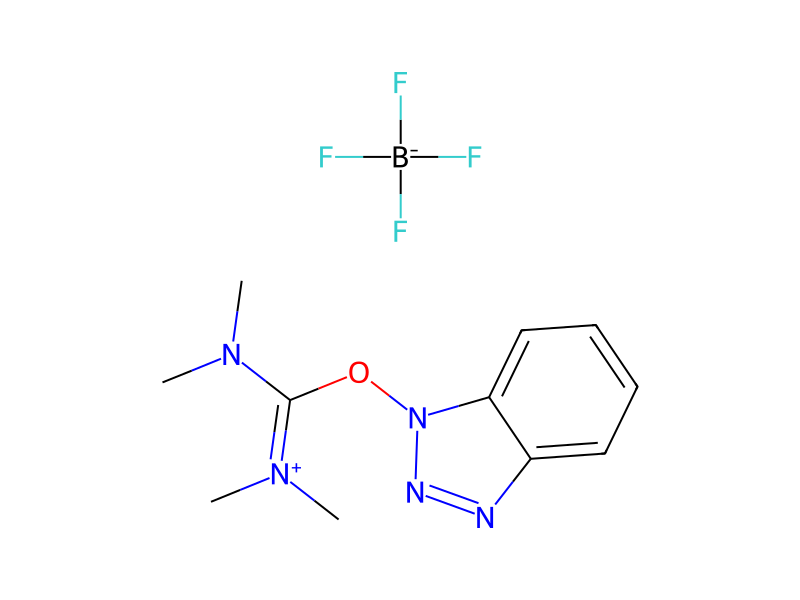
[CH:1]([C:3]1[CH:18]=[CH:17][C:6]([O:7][C:8]2[CH:9]=[C:10]([CH:14]=[CH:15][CH:16]=2)[C:11]([OH:13])=O)=[CH:5][CH:4]=1)=[O:2].CC[N:21]([CH:25]([CH3:27])C)[CH:22]([CH3:24])C.CN(C(ON1N=NC2C=CC=CC1=2)=[N+](C)C)C.[B-](F)(F)(F)F.N1CCCC1>CN(C=O)C>[N:21]1([C:11]([C:10]2[CH:9]=[C:8]([CH:16]=[CH:15][CH:14]=2)[O:7][C:6]2[CH:5]=[CH:4][C:3]([CH:1]=[O:2])=[CH:18][CH:17]=2)=[O:13])[CH2:22][CH2:24][CH2:27][CH2:25]1Participants
6





Procedure
1 g (4.1 mmol) of 3-(4-formyl-phenoxy)-benzoic acid were dissolved in 25 ml DMF and combined with 0.86 ml (4.95 mmol) of DIPEA and 1.32 g (4.1 mmol) of TBTU, stirred for 5 min at ambient temperature and then 0.29 g (4.1 mmol) of pyrrolidine were added. The mixture was stirred at ambient temperature, filtered through basic Alox, concentrated by rotary evaporation and purified by chromatography (silica gel column, dichloromethane with gradient of 0-10% methanol).
Workup
- stirringThe mixture was stirred at ambient temperature
- filtrationfiltered through basic Alox
- concentrationconcentrated by rotary evaporation
- custompurified by chromatography (silica gel column, dichloromethane with gradient of 0-10% methanol)
Sources & evidence
- ORD record
- ord-0e7e2ef3c54a4606be3a245ee1a05843
- Source dataset
- uspto-grants-2014_12
- Patent number
- US08916589B2
Reaction notes
Loading…