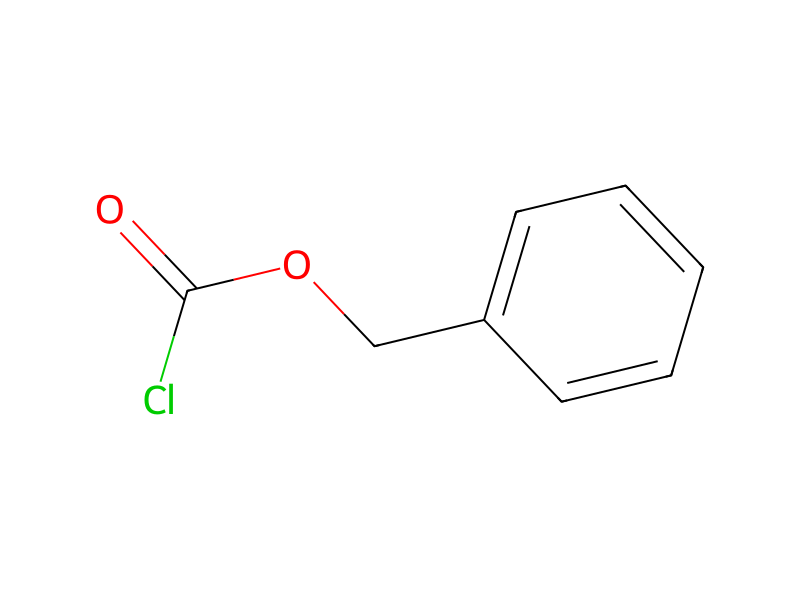
Benzyl chloroformate → Carbamic acid, [3-fluoro-4-(3-thiazolidinyl)phenyl]-, phenylmethyl ester
Reaction equation

[F:1][C:2]1[CH:7]=[C:6]([N+:8]([O-])=O)[CH:5]=[CH:4][C:3]=1[N:11]1[CH2:15][CH2:14][S:13][CH2:12]1.[H][H].C(=O)(O)[O-].[Na+].Cl[C:24]([O:26][CH2:27][C:28]1[CH:33]=[CH:32][CH:31]=[CH:30][CH:29]=1)=[O:25]>O1CCCC1.[Ni].C(OCC)(=O)C.O>[F:1][C:2]1[CH:7]=[C:6]([NH:8][C:24]([O:26][CH2:27][C:28]2[CH:33]=[CH:32][CH:31]=[CH:30][CH:29]=2)=[O:25])[CH:5]=[CH:4][C:3]=1[N:11]1[CH2:15][CH2:14][S:13][CH2:12]1Participants
Reactant 4



Product 1

Reagents, catalysts & solvents 4




Procedure
The 3-(2-fluoro-4-nitrophenyl)thiazolidine (1.485 g, 6.513 mmol) was dissolved in tetrahydrofuran (25 mL) and water (5 mL) and then shaken under 40 psi of hydrogen in the presence of Raney nickel (500 mg) for 5 hours. After this time, the mixture was filtered over diatomaceous earth. The filter pad was washed with methanol and the filtrate was concentrated to an aqueous layer. Water (15 mL) and acetone (25 mL) were added to the aqueous mixture and the mixture was cooled in an ice bath. Solid sodium bicarbonate (2.728 g, 32.47 mmol) was added followed by benzyl chloroformate (3.0 mL, 21.01 mmol). The mixture was allowed to warm to room temperature and stirred over 3 nights. Ethyl acetate was added to the mixture and the layers were separated. The aqueous layer was extracted with ethyl acetate (3×). The combined organic layers were dried (MgSO4) and concentrated under reduced pressure to provide 3.925 g crude material as a dark oil. The crude was chromatographed on a silica gel column (27 cm×4.5 cm, 40-63 μ), eluting with 500 mL 40% hexane/methylene chloride, 1L 20% hexane/methylene chloride, 500 mL 10% hexane/methylene chloride, 500 mL methylene chloride and 500 mL 3% methanol/methylene chloride to provide 480 mg of the title compound as yellow solids and 950 mg of the title compound contaminated with benzyl alcohol. In order to remove the benzyl alcohol contaminate, the contaminated material was treated with triethyl amine (0.6 mL, 4.31 mmol), butyric anhydride (0.45 mL, 2.86 mmol) and a small amount of 4-dimethylamino pyridine at 0° C. After 35 minutes the mixture was concentrated and chromatographed on a silica gel column (23.5 cm×2.5 cm, 40-63 μ), eluting with 250 mL 10% ethyl acetate/hexane and 500 mL 15% ethyl acetate/hexane to provide 700 mg of the title compound as light yellow solids. In all, 1.180 g (59%) of the title compound was obtained. Recrystallization from ethyl ether/hexane provided an analytical sample with a melting point of 90°-92° C.
Workup
- filtrationAfter this time, the mixture was filtered over diatomaceous earth
- washThe filter pad was washed with methanol
- concentrationthe filtrate was concentrated to an aqueous layer
- additionWater (15 mL) and acetone (25 mL) were added to the aqueous mixture
- temperaturethe mixture was cooled in an ice bath
- customthe layers were separated
- extractionThe aqueous layer was extracted with ethyl acetate (3×)
- dry with materialThe combined organic layers were dried (MgSO4)
- concentrationconcentrated under reduced pressure
- customto provide 3.925 g crude material as a dark oil
- customThe crude was chromatographed on a silica gel column (27 cm×4.5 cm, 40-63 μ)
- washeluting with 500 mL 40% hexane/methylene chloride, 1L 20% hexane/methylene chloride, 500 mL 10% hexane/methylene chloride, 500 mL methylene chloride and 500 mL 3% methanol/methylene chloride
Sources & evidence
- ORD record
- ord-2b805600f3d64d11b51928e2eba9e36e
- Source dataset
- uspto-grants-1999_03
- Patent number
- US05880118
Reaction notes
Loading…