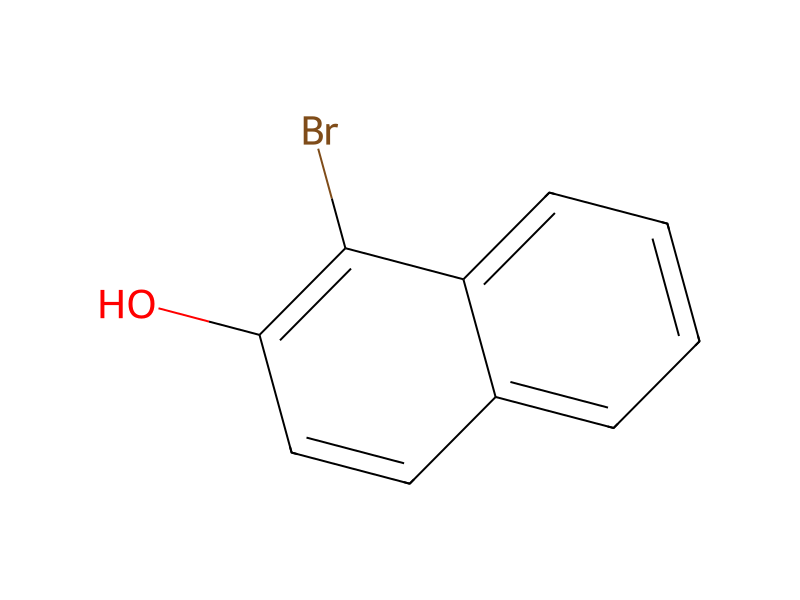
1-Bromo-2-naphthol → 1-(3-Chloro-2-fluorophenyl)-2-naphthol
Reaction equation

Br[C:2]1[C:11]2[C:6](=[CH:7][CH:8]=[CH:9][CH:10]=2)[CH:5]=[CH:4][C:3]=1[OH:12].[Cl:13][C:14]1[C:15]([F:23])=[C:16](B(O)O)[CH:17]=[CH:18][CH:19]=1.C1(C)C=CC=CC=1P(C1C=CC=CC=1C)C1C=CC=CC=1C.C(=O)([O-])[O-].[K+].[K+]>C([O-])(=O)C.[Pd+2].C([O-])(=O)C.C(O)C.C1(C)C=CC=CC=1>[Cl:13][C:14]1[C:15]([F:23])=[C:16]([C:2]2[C:11]3[C:6](=[CH:7][CH:8]=[CH:9][CH:10]=3)[CH:5]=[CH:4][C:3]=2[OH:12])[CH:17]=[CH:18][CH:19]=1Participants
8
Reactant 4



Product 1

Reagents, catalysts & solvents 3



Procedure
Into a 200 mL three-neck flask were put 5.8 g (26 mmol) of 1-bromo-2-naphthol, 4.5 g (26 mmol) of 3-chloro-2-fluorobenzeneboronic acid, and 0.40 g (1.3 mol) of tri(ortho-tolyl)phosphine, and the air in the flask was replaced with nitrogen. To this mixture were added 150 mL of toluene, 50 mL of ethanol, and 21 mL of an aqueous solution of potassium carbonate (2.0 mol/L). The mixture was degassed by being stirred while the pressure in the flask was reduced, and then the air in the flask was replaced with nitrogen. To this mixture was added 58 mg (0.26 mmol) of palladium(II) acetate, and the resulting mixture was stirred at 90° C. under a nitrogen stream for 7 hours.
Workup
- customInto a 200 mL three-neck flask were put
- customThe mixture was degassed
- stirringthe resulting mixture was stirred at 90° C. under a nitrogen stream for 7 hours
Sources & evidence
- ORD record
- ord-1aa2b727bc634af380bda99e2bc45a4c
- Source dataset
- uspto-grants-2015_07
- Patent number
- US09093649B2
Reaction notes
Loading…