Sorbitol → (2R,3S,4R,5R)-2,3,4,5,6-pentahydroxyhexanal
Reaction equation

[BH4-].[Na+].C1(C)C=CC(S(Cl)(=O)=O)=CC=1.NN.[CH2:16]([OH:27])[C@@H:17]([C@H:19]([C@@H:21]([C@@H:23]([CH2:25][OH:26])[OH:24])[OH:22])[OH:20])[OH:18].I([O-])(=O)(=O)=O.C([BH3-])#N.[Na+]>N1C=CC=CC=1>[O:26]=[CH:25][C@@H:23]([C@H:21]([C@@H:19]([C@@H:17]([CH2:16][OH:27])[OH:18])[OH:20])[OH:22])[OH:24]Participants
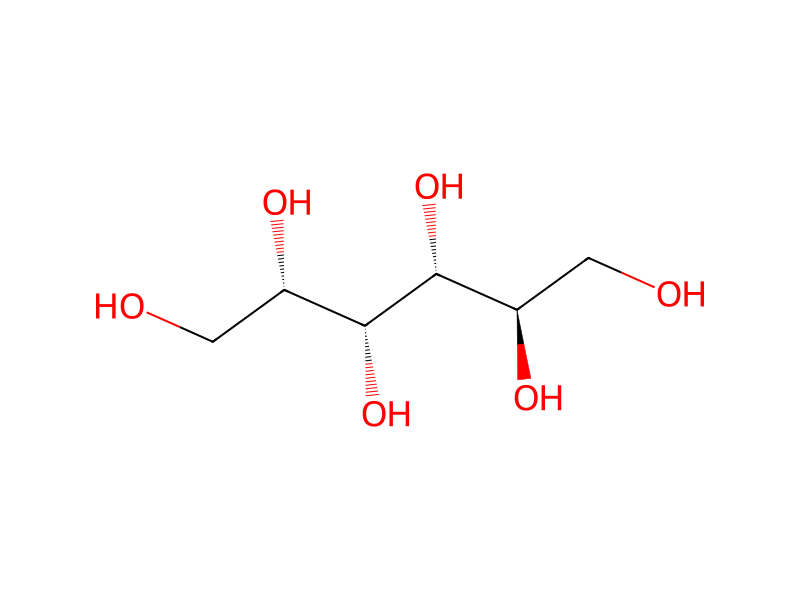





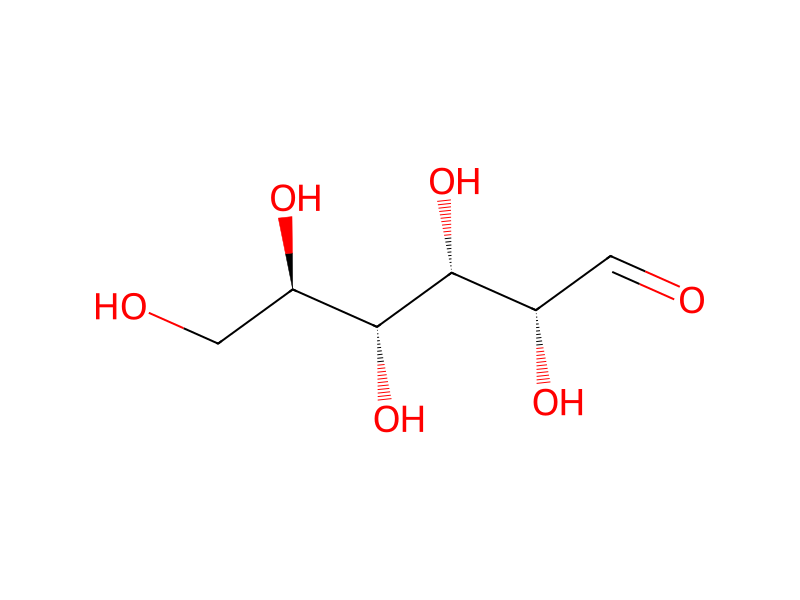

Conditions
- Temperature
- 100 °C
Procedure
Sodium borohydride reduced dextrans are reacted with p-toluenesulfonyl chloride. The product, mainly 6-O-p-tolylsufonyldextran is converted into the 6-hydrazino-6-deoxydextran by refluxing with hydrazine and the product is coupled to the carboxylated microspheres. As dextran is mainly a 1-6 glycan, the nitrogen functions are mainly located at the original terminal primary hydroxyls; for instance Cl of the reducing end glucitol and C6 of the non-reducing end glucopyranoside. The periodate oxidized IgG is then directly coupled to the terminal hydrazines via reductive amination with sodium cyanoborohydride. This approach reduces the number of coupling steps considerably. The hydrazinodextrans are prepared in bulk and characterized in respect to molecular weight and substitution. Procedure: Dextran (10,000 MW) 32.4 g is dissolved in 200 ml of 95% pyridine and water is removed at 60° C. by rotary evaporation. To the swollen dextran in 2 hours is added 85 grams of p-toluenesulfonyl chloride and the mixture kept for 24 hours at 25° C. After addition of 100 grams of ice and 100 ml of methanol, the mixture is agitated in a blender and the powder is washed with 80% methanol and dried. Twenty-five grams of this material is refluxed for 7 days with 35 ml of anhydrous hydrazine under nitrogen. Excess hydrazine is removed in vacuo and the residue dissolved in 5% acetic acid, dialyzed against water, and lyophilized. This material is analyzed for sugar content and hydrazinosugars by ion exchange chromatography. To calibrate against known compounds the hydrazinodextran is reduced with excess Raney-nickel (1 g/g/10 ml water of hydrazinodextran) for 24 hours. After heating to 100° C., the catalyst is removed by filtration and the product dialyzed and lyophilized. Hydrolysis and analysis for constituents gives a high ratio of glucose: 6-amino-6-deoxyglucose : 1-amino-1-deoxy-D-glucitol (D-glucamine) [50:1]. Coupling of the hydrazinodextran to the succinylated microsphere would be accomplished using EDC as described under method 2 above.
Workup
- customThe hydrazinodextrans are prepared in bulk
- customwater is removed at 60° C. by rotary evaporation
- additionTo the swollen dextran in 2 hours is added 85 grams of p-toluenesulfonyl chloride
- additionAfter addition of 100 grams of ice and 100 ml of methanol
- washthe powder is washed with 80% methanol
- customdried
- temperatureTwenty-five grams of this material is refluxed for 7 days with 35 ml of anhydrous hydrazine under nitrogen
- customExcess hydrazine is removed in vacuo
- dissolutionthe residue dissolved in 5% acetic acid
- customdialyzed against water
- waitis reduced with excess Raney-nickel (1 g/g/10 ml water of hydrazinodextran) for 24 hours
- customthe catalyst is removed by filtration
- customthe product dialyzed
- customHydrolysis and analysis for constituents
Sources & evidence
- ORD record
- ord-b023539ce9c247dd966df9cfbf4f0c7e
- Source dataset
- uspto-grants-1993_06
- Patent number
- US05216130
Reaction notes
Loading…