Tryptamine → Diisopropylethylamine
Reaction equation

NCC[C:4]1[C:12]2[C:7](=[CH:8]C=CC=2)[NH:6][CH:5]=1.C(Cl)Cl.C(Cl)(Cl)Cl.O1[CH2:24][CH2:23][CH2:22]C1>N1C=CC=CC=1.C(N(CC)CC)C.C(OCC)C>[CH:23]([N:6]([CH:7]([CH3:12])[CH3:8])[CH2:5][CH3:4])([CH3:24])[CH3:22]Participants
Reactant 4
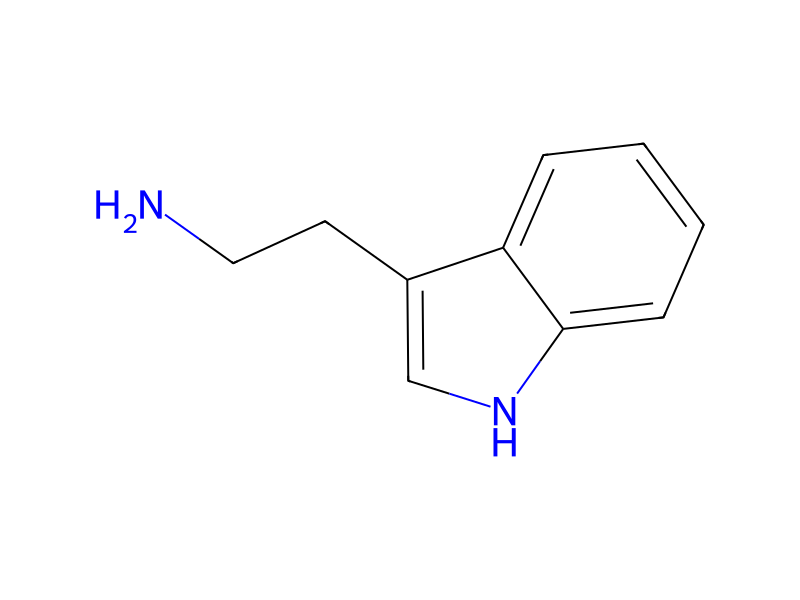



Product 1

Reagents, catalysts & solvents 3



Procedure
As shown in reaction Scheme B, the 2-aryltryptamine may be condensed with a carboxylic acid of type (6) using the coupling reagent 1-(3-dimethylaminopropyl)-3-ethylcarbodiimide hydrochloride (EDC), 1,3-dicyclohexylcarbodiimide (DCC) or the like with or without 1-hydroxybenzotriazole (HOBt) and a tertiary amine base such as N-methylmorpholine (NMM), triethylamine or the like in an inert organic solvent such as methylene chloride, chloroform, dimethylformamide, or mixtures thereof at or near room temperature for a period of 3-24 hours to provide the corresponding amide derivative (7). Alternatively, 2-aryltryptamine (5) can be treated with an active ester or acid chloride of type (8) in an inert organic solvent such as methylene chloride, chloroform, tetrahydrofuran, diethyl ether, or the like and a tertiary amine base such as triethylamine, diisopropylethylamine, pyridine or the like at a temperature of 0°-25° C. for 30 minutes to 4 hours to give (7). ##STR11##
Sources & evidence
- ORD record
- ord-f3fed61387314427a8b7bf1090d1c7d7
- Source dataset
- uspto-grants-1999_11
- Patent number
- US05981550
Reaction notes
Loading…