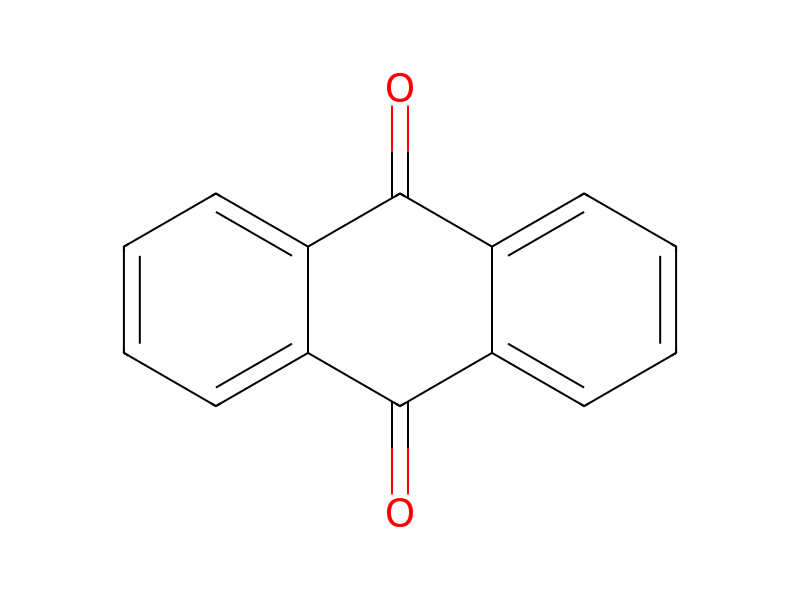
Potassium Carbonate → Anthraquinone
Reaction equation

Cl[C:2]1[CH:9]=[CH:8][C:5]([CH2:6][OH:7])=[CH:4][CH:3]=1.[C:10](=[O:13])([O-])[O-].[K+].[K+]>CN(C=O)C>[CH:3]1[C:4]2[C:10](=[O:13])[C:9]3[C:2](=[CH:3][CH:4]=[CH:5][CH:8]=3)[C:6](=[O:7])[C:5]=2[CH:8]=[CH:9][CH:2]=1Participants
4
Reactant 2


Product 1
Reagents, catalysts & solvents 1

Procedure
Subsequently, in 70 ml of DMF, 3.5 g of the compound (F), 2.4 g of p-chlorobenzyl alcohol and 12 g of potassium carbonate were stirred at 120° C. for 5 hours. After filtration, DMF was removed under reduced pressure, and purification was carried out by column chromatography to yield 2.5 g of the target anthraquinone dye No. 8.
Workup
- filtrationAfter filtration, DMF
- customwas removed under reduced pressure, and purification
Sources & evidence
- ORD record
- ord-47fdbd0a6ab94c6e9863c6fc40522345
- Source dataset
- uspto-grants-2003_01
- Patent number
- US06509125B1
Reaction notes
Loading…