Water → 1-Bromo-4-[(prop-2-en-1-yl)oxy]benzene
Reaction equation

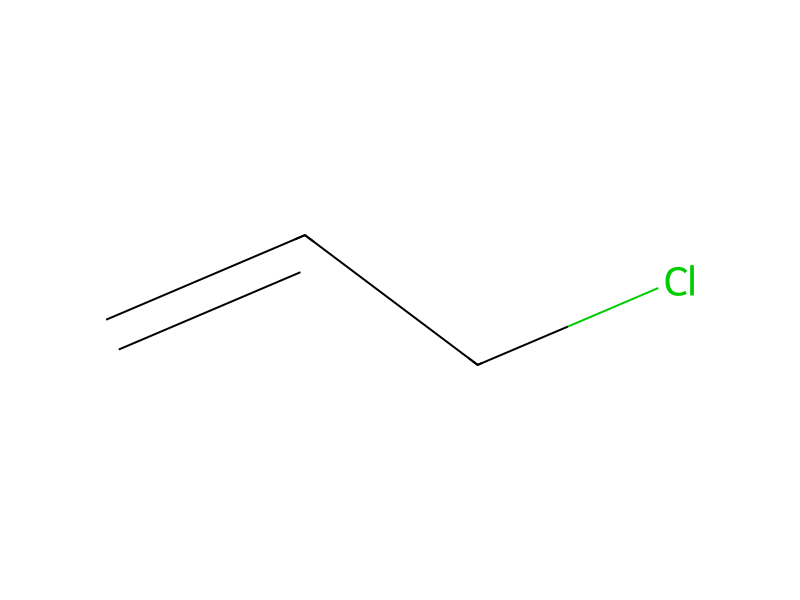
[Br:1][C:2]1[CH:7]=[CH:6][C:5]([OH:8])=[CH:4][CH:3]=1.[H-].[Na+].[CH2:11](Cl)[CH:12]=[CH2:13].O>O1CCCC1.CN(C)C=O.CCCCCC>[CH2:13]([O:8][C:5]1[CH:6]=[CH:7][C:2]([Br:1])=[CH:3][CH:4]=1)[CH:12]=[CH2:11]Participants







Procedure
A solution of 4-bromophenol (1 mol) in tetrahydrofuran (500 mL) was added to a slurry of sodium hydride (1.17 mol) in dimethylformamide (1.2 L) at 25° C. After complete reaction allylchloride (1.32 mol) was added and after stirring for a further 3 h at 45° the product was isolated with water and hexane. Distillation gave allyl-(4-bromophenyl)ether. bp. 65-67° at 0.1 mm (82%). This material was heated at 195° with dimethylanaline for 4 hours and then distilled to yield 2-allyl-4-bromophenol (0.81 mol). A solution of this material (0.81 mol) in tetrahydrofuran (200 mL) was added to a mixture of 1-bromononane (0.8 mol), sodium hydride (0.92 mol) potassium iodide (1 g) in dimethylformamide (lL) at 25° C After hydrogen evaluation was complete the mixture was heated at 50o for 14 h, cooled, added to an excess of water and extracted with hexane. Distillation furnished nonyl-(2-allyl-4-bromophenyl)ether (256 g): b.p. 147-156° at 0.1 mm. This material (255 g) in dimethylsulfoxide (1 L) and tetrahydrofuran (0 5 L) was heated at 35-40° with potassium tert. butoxide (2 g) for 2 h and then quenched with acetic acid (5 mL) and water. Isolation of the reaction products with hexane yielded pure 1-[2-(nonyloxy)-5-(bromo)phenyl]propene (234 g): b.p. 145-155° at 0.1 mm. A solution of the above material (0.56 mol) in tetrahydrofuran (600 mL) was converted to the Grignard reagent with magnesium (1 mol) at 55 C for 3 h. After complete reaction the mixture was cooled to 0° C and treated with trimethylborate (0.75 mol) in ether (200 mL). After stirring for a further 30 min. at 25° C the mixture was cooled to 0° and exposed to a mixture of ammonium chloride (10%) and hydrogen peroxide (10%, 500 mL) and stirred for a further lh at 25oC Addition of water and hexane gave the crude material after removal of the hexane in vacuo. The crude product was passed through a plug of silica gel to yield para [2-(1-propenyl-4-(nonyloxy)phenyl]phenol (73 g). Acetylation of this material (0.8 g) with acetylchloride and triethylamine in dichloromethane gave the [2-(1-propenyl)-4-(nonyloxy)-1-(acetoxy)]benzene (89%). This material (99 g) was dissolved in a mixture of methanol (150 mL) and dichloromethane (1.5 L) and treated with ozone at -40oC until all the starting material had been consumed. Dimethylsulfide (50 mL) and water (500 mL) were then added and after vigorous stirring for 30 min. at 25° the organic phase was dried (MgSO4) and concentrated to yield [2-(nonyloxy)-5-(acetoxy)]benzaldehyde (83 g). Reduction of this material (80 g) with sodium borohydride (6 g) in ethanol (lL) at 20° C for 2 h gave the crude [2-(nonyloxy)-5-(acetoxy)]benzenemethanol which was immediately exposed to aqueous potassium hydroxide (300 mL, 40%) in ethanol (lL) for 30 min at 60° C. Acidification with aqueous acid (6 Molar hydrogen chloride) and extraction with chloroform yielded the crude product on concentration. Digestion of the residue with hexane gave pure [3-(hydroxymethyl)-4-(nonyloxy)]phenol (63 g) as a solid. A solution of this material (62 g) in a mixture of acetonitrile (0.5 L) and trihenylphosphine hydrobromide (86 g) was heated at reflux for 14 h and concentrated to dryness at 50° C to yield [[2-(nonyloxy)-5(hydroxy)phenyl]methyl]triphenylphosphonium bromide as a glass.
Workup
- additionwas added
- distillationDistillation
Sources & evidence
- ORD record
- ord-95975bf69cff49ef8f2fff1a7e6f048e
- Source dataset
- uspto-grants-1989_11
- Patent number
- US04883614
Reaction notes
Loading…