3-Aminoquinoline → (2-Chloropyrimidin-4-yl)quinolin-3-ylamine
Reaction equation

[Cl:1][C:2]1[N:7]=[C:6](Cl)[CH:5]=[CH:4][N:3]=1.[NH2:9][C:10]1[CH:11]=[N:12][C:13]2[C:18]([CH:19]=1)=[CH:17][CH:16]=[CH:15][CH:14]=2.C(N(C(C)C)C(C)C)C>CC(O)C>[Cl:1][C:2]1[N:7]=[C:6]([NH:9][C:10]2[CH:11]=[N:12][C:13]3[C:18]([CH:19]=2)=[CH:17][CH:16]=[CH:15][CH:14]=3)[CH:5]=[CH:4][N:3]=1Participants
5
Reactant 3
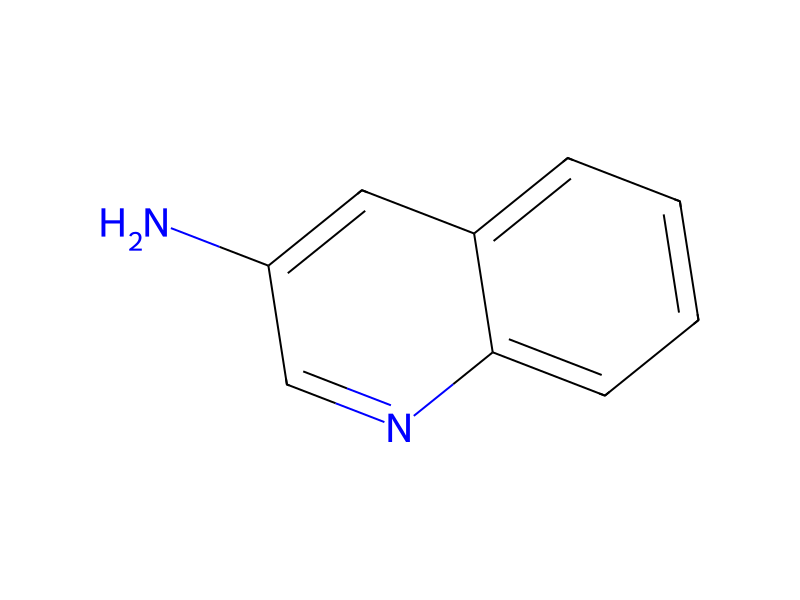


Product 1

Reagents, catalysts & solvents 1

Procedure
50 g (0.34 mol) of 2,4-dichloropyrimidine and 50 g (0.35 mol) of 3-amino-quinoline are combined and kept at the boil under reflux for 50 h in 400 ml of 2-propanol with 100 ml of ethyldiisopropylamine. The reaction mixture is poured into 3 l of ice-water, the precipitate is filtered off with suction and washed with water. The residue is recrystallised from acetone, giving 60 g of pale-grey crystals (m.p.: 140-143° C.) (2-chloropyrimidin-4-yl)quinolin-3-ylamine.
Workup
- filtrationthe precipitate is filtered off with suction
- washwashed with water
- customThe residue is recrystallised from acetone
Sources & evidence
- ORD record
- ord-4fa377dae9a74f378f1d129a4b7490a4
- Source dataset
- uspto-grants-2012_02
- Patent number
- US08114882B2
Reaction notes
Loading…