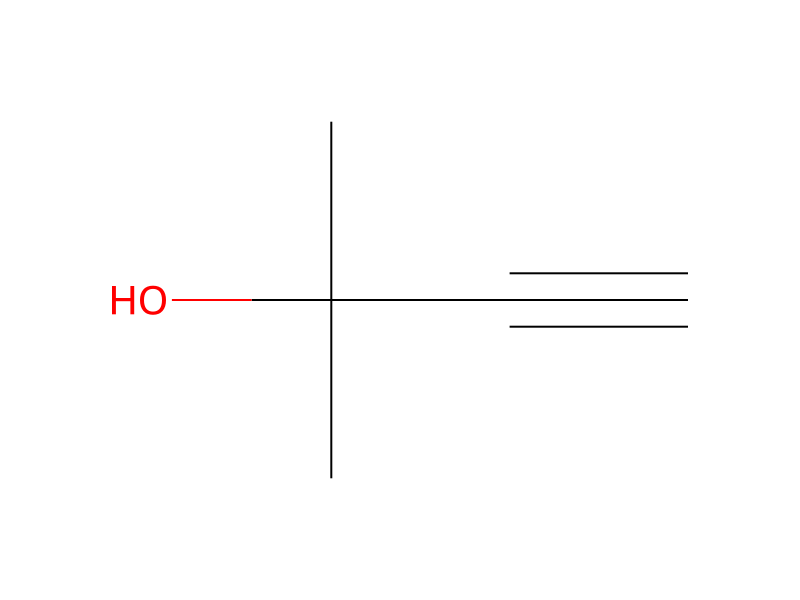
2-Methyl-3-butyn-2-ol → 4-(4-fluorophenyl)-2-methylbut-3-yn-2-ol
Reaction equation

Br[C:2]1[CH:7]=[CH:6][C:5]([F:8])=[CH:4][CH:3]=1.[OH:9][C:10]([CH3:14])([CH3:13])[C:11]#[CH:12].P(C1C=CC=CC=1)(C1C=CC=CC=1)C1C=CC=CC=1>C(N(CC)CC)C.[Pd].[Cu]I>[F:8][C:5]1[CH:6]=[CH:7][C:2]([C:12]#[C:11][C:10]([OH:9])([CH3:14])[CH3:13])=[CH:3][CH:4]=1Participants
Reactant 3


Product 1

Reagents, catalysts & solvents 3



Conditions
- Temperature
- 70 °C
Procedure
To a solution of 35.2 g (0.19 mole) of 4-bromofluorobenzene and 25.2 g (0.3 mole) of 3-hydroxy-3-methyl-1-butine in 250 ml of triethylamine are added, under nitrogen, 1 g of the palladium complex PdCl2 [P(C6H5)3 ]2 and 0.2 g of copper(I) iodide. The reaction mixture is subsequently stirred for 24 hours at 70° C. After filtering off triethylammonium bromide and removing excess triethylamine by evaporation, the residue is taken up in 200 ml of ether and the solution is washed twice with 100 ml of 5% aqueous HCl solution and 100 ml of water, dried, treated with activated charcoal, and evaporated to dryness. The residue is chromatographed on silica gel with a 1:1 mixture of ether/hexane, affording 26.4 g (78%) of 1-fluoro-4-(3-hydroxy-3-methyl-1-butyn-1-yl)-benzene with a melting point of 124° C.
Workup
- filtrationAfter filtering off triethylammonium bromide
- customremoving excess triethylamine
- customby evaporation
- washthe solution is washed twice with 100 ml of 5% aqueous HCl solution and 100 ml of water
- customdried
- additiontreated with activated charcoal
- customevaporated to dryness
- customThe residue is chromatographed on silica gel with a 1:1 mixture of ether/hexane
Sources & evidence
- ORD record
- ord-2d038cce83ad48b49d4cff65137d7350
- Source dataset
- uspto-grants-1983_11
- Patent number
- US04412856
Reaction notes
Loading…