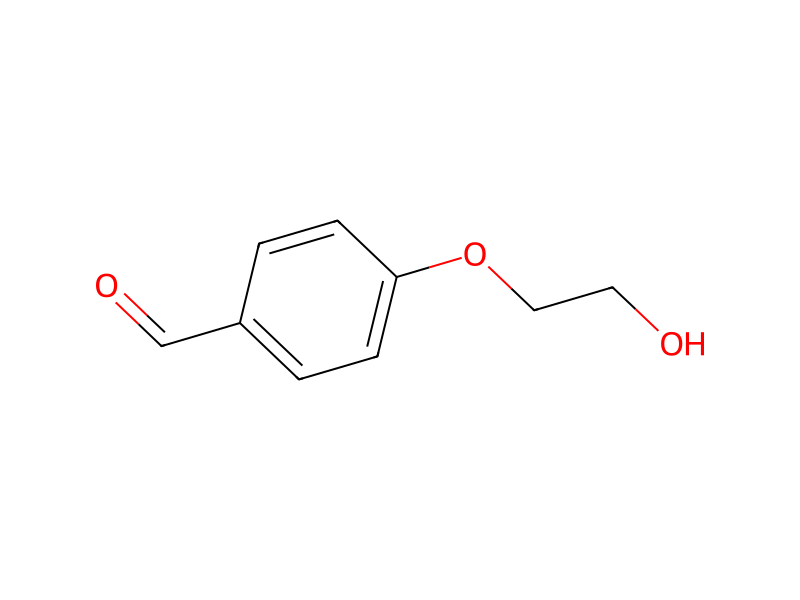
4-Hydroxybenzaldehyde → Benzaldehyde, 4-(2-hydroxyethoxy)-
Reaction equation

[OH:1][C:2]1[CH:9]=[CH:8][C:5]([CH:6]=[O:7])=[CH:4][CH:3]=1.C(=O)([O-])[O-].[K+].[K+].CN(C)C=O.Br[CH2:22][CH2:23][OH:24]>O>[OH:24][CH2:23][CH2:22][O:1][C:2]1[CH:9]=[CH:8][C:5]([CH:6]=[O:7])=[CH:4][CH:3]=1Participants
Reactant 4




Product 1
Reagents, catalysts & solvents 1

Conditions
- Temperature
- 60 °C
Procedure
12.2 g (0.1 mol) of 4-hydroxybenzaldehyde, 16.6 g (0.12 mol) of potassium carbonate and 100 ml of N,N-dimethylformamide were put in a three-neck 300 ml-flask equipped with a thermometer and a stirrer and heated up to 60° C. To this mixture was dropwise added 25.0 g (0.2 mol) of 2-bromoethanol. The internal temperature rose up to 80° C. due to the reaction heat. Afterwards, the reaction system was heated and stirred at 100° C. for 2 hours. The reaction mixture was cooled to room temperature, poured into water and extracted with ethyl acetate. The resulting extract was dried with anhydrous sodium sulfate, and ethyl acetate was removed therefrom by distillation. The residue was subjected to silica gel column chromatography (using an eluent of ethyl acetate/n-hexane of 1/1) to obtain the intended 4-(2-hydroxyethoxy)benzaldehyde as an oily product. The yield of the product was 5.8 g (34.9%).
Workup
- custom300 ml-flask equipped with a thermometer and a stirrer
- customrose up to 80° C. due to the reaction
- temperatureheat
- temperatureAfterwards, the reaction system was heated
- temperatureThe reaction mixture was cooled to room temperature
- extractionextracted with ethyl acetate
- extractionThe resulting extract
- dry with materialwas dried with anhydrous sodium sulfate, and ethyl acetate
- customwas removed
- distillationby distillation
Sources & evidence
- ORD record
- ord-4a3ac83609654d238f7a5a975d752e54
- Source dataset
- uspto-grants-1995_04
- Patent number
- US05408009
Reaction notes
Loading…