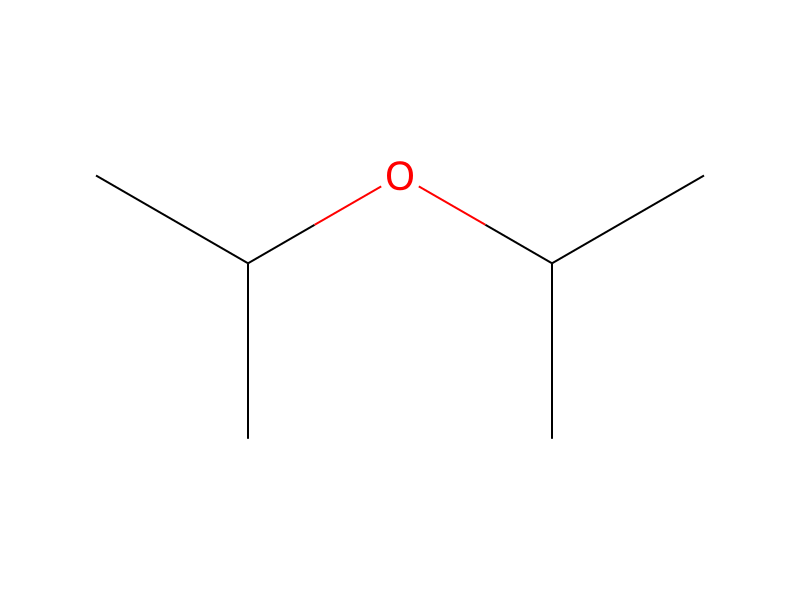
Diisopropyl Ether → 2-(2,5-Dimethyl-1H-pyrrol-1-yl)-5-methoxypyridine
Reaction equation

[Na].[CH3:2][C:3]1[N:4]([C:9]2[CH:14]=[CH:13][C:12](I)=[CH:11][N:10]=2)[C:5]([CH3:8])=[CH:6][CH:7]=1.[CH:16]([O:19]C(C)C)(C)C.[NH4+].[Cl-]>CO.[Cu]I.CN(C=O)C>[CH3:2][C:3]1[N:4]([C:9]2[CH:14]=[CH:13][C:12]([O:19][CH3:16])=[CH:11][N:10]=2)[C:5]([CH3:8])=[CH:6][CH:7]=1Participants
Reactant 4



Product 1

Reagents, catalysts & solvents 3



Conditions
- Temperature
- 80 °C
Procedure
Sodium (3.0 equiv., 735 mmol, 16.9 g) was dissolved in dry methanol (240 ml). DMF (160 ml), CuI (0.15 equiv., 37 mmol, 7.0 g) and N-protected 2-(2,5-dimethyl-1H-pyrrol-1-yl)-5-iodo-pyridine (I17) (1.0 equiv., 245 mmol, 73.0 g) were added. The reaction mixture was heated to 80° C. for 3 h. After the mixture had been allowed to cool to room temperature, isopropylether and an aqueous NH4Cl solution (5%) were added, the mixture was stirred overnight. The solids were filtered off over Celite and the filtrate was extracted several times with dichloromethane. The combined organic phases were washed with a 10% aqueous NH4OH solution, dried with MgSO4 and concentrated in vacuo. After drying in high vacuum, 2-(2,5-dimethyl-1H-pyrrol-1-yl)-5-methoxy-pyridine (I18) (50 g, yield=100%) was pure enough to be used as such in the next step. 1H NMR (δ, CDCl3): 2.08 (6H, s), 3.91 (3H, s), 5.87 (2H, s), 7.15 (1H, d, J=8.7 Hz), 7.32 (1H, dd, J=8.7, 3.0 Hz), 8.27 (1H, d, J=3.0 Hz)
Workup
- temperatureto cool to room temperature
- filtrationThe solids were filtered off over Celite
- extractionthe filtrate was extracted several times with dichloromethane
- washThe combined organic phases were washed with a 10% aqueous NH4OH solution
- dry with materialdried with MgSO4
- concentrationconcentrated in vacuo
Sources & evidence
- ORD record
- ord-03e4e0ac1de2456db6a43b8e27b5ec00
- Source dataset
- uspto-grants-2011_08
- Patent number
- US07994187B2
Reaction notes
Loading…