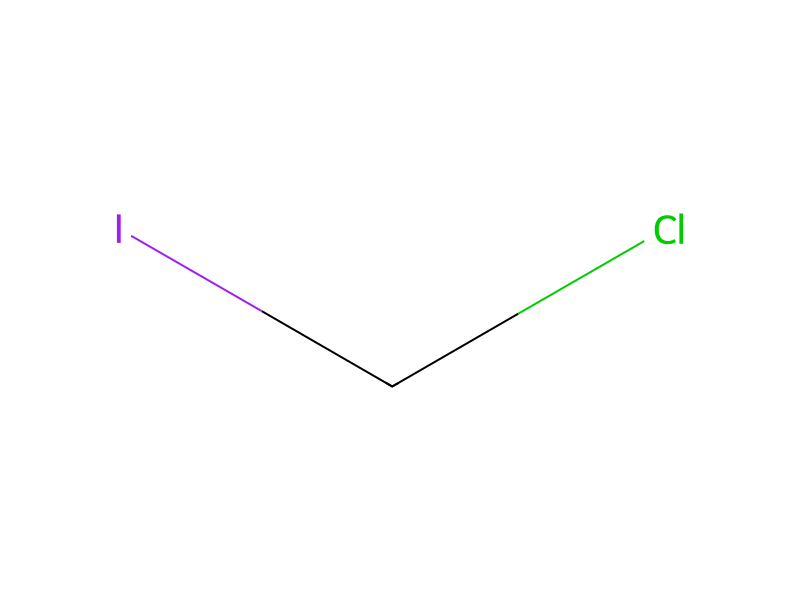
Chloroiodomethane → Methyl 3-cyano-4-hydroxybenzoate
Reaction equation

O[C:2]1C=[CH:10][C:5]([C:6]([O:8][CH3:9])=[O:7])=[CH:4][C:3]=1I.ClCI.C([Zn][CH2:19][CH3:20])C.[NH4+:21].[Cl-].[NH4+].[OH-:24]>ClCCCl.CCOC(C)=O>[C:2]([C:3]1[CH:4]=[C:5]([CH:10]=[CH:19][C:20]=1[OH:24])[C:6]([O:8][CH3:9])=[O:7])#[N:21]Participants
Reactant 5




Product 1

Reagents, catalysts & solvents 2


Conditions
- Temperature
- 0 °C
Procedure
Compound 2 (5.56 g, 24.0 mmol) was combined with chloroiodomethane (5.59 mL, 76.8 mmol) and dissolved in 1,2-dichloroethane (35 mL) under an atmosphere of nitrogen. The solution was cooled to 0° C. with an ice bath and diethyl zinc (38.4 mL, 1.0 M in hexanes, 38.4 mmol) was added over 10 minutes. The resulting mixture was stirred for 30 minutes and allowed to warm to room temperature. It was cooled to 0° C. with an ice bath, and saturated aqueous NH4Cl (150 mL) was added, followed by concentrated aqueous NH4OH (25 mL) and EtOAc (200 mL). The layers were separated and the aqueous phase was extracted with additional EtOAc (2×100 mL). The organic phases were combined, dried (Na2SO4) and concentrated to a crude oil which was purified using silica gel (100% hexanes). Compound 3 (1.76 g, 7.2 mmol, 30% yield) was a colorless oil which was characterized using 1H NMR.
Workup
- temperatureto warm to room temperature
- temperatureIt was cooled to 0° C. with an ice bath
- customThe layers were separated
- extractionthe aqueous phase was extracted with additional EtOAc (2×100 mL)
- dry with materialdried (Na2SO4)
- concentrationconcentrated to a crude oil which
- customwas purified
Sources & evidence
- ORD record
- ord-4bc7e30e29c144448240b1fb9a5e273f
- Source dataset
- uspto-grants-2010_09
- Patent number
- US07795448B2
Reaction notes
Loading…