Triethylamine → HCID 68745035, compound
Reaction equation

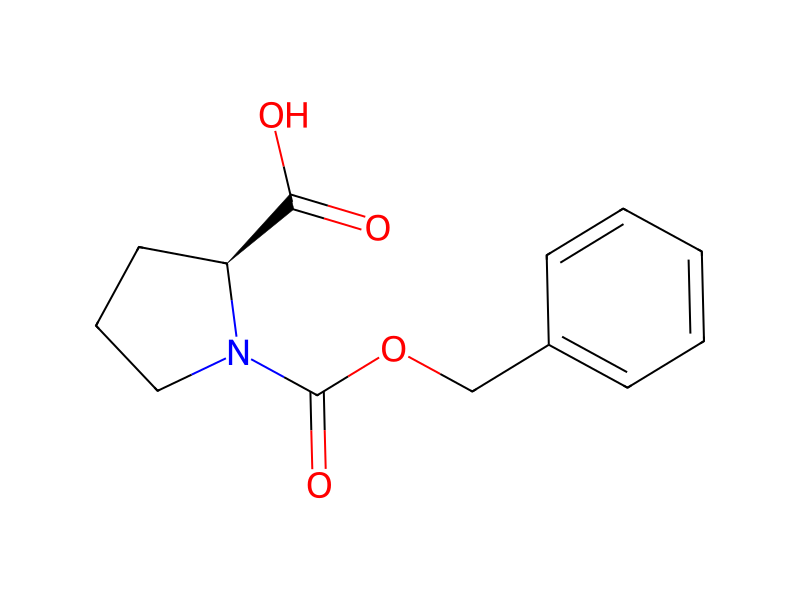
[CH2:1]([O:8][C:9]([N:11]1[CH2:18][CH2:17][CH2:16][C@H:12]1[C:13]([OH:15])=O)=[O:10])[C:2]1[CH:7]=[CH:6][CH:5]=[CH:4][CH:3]=1.C(N1C=CN=C1)([N:21]1[CH:25]=[CH:24]N=C1)=O.Cl.C[O:33]C(=O)CN.C(N(CC)CC)C>O1CCCC1>[CH2:1]([O:8][C:9]([N:11]1[CH2:12][C:13](=[O:15])[N:21]2[CH2:25][CH2:24][CH2:16][C@H:17]2[C:18]1=[O:33])=[O:10])[C:2]1[CH:3]=[CH:4][CH:5]=[CH:6][CH:7]=1Participants





Procedure
In 150 ml of tetrahydrofuran, 12.5 g of N-benzyloxycarbonyl-L-proline and 8.9 g of carbonyldiimidazole were dissolved and stirred for 30 minutes. Then 6.9 g of glycine methyl ester hydrochloride and 5.6 g of triethylamine were added to the solution and stirred for an overnight at room temperature. The solution was concentrated, and ethyl acetate was added, followed by washing with saturated aqueous sodium hydrogencarbonate solution, 10% aqueous citric acid and saturated brine, drying over anhydrous magnesium sulfate and concentration. The residue was dissolved in 100 ml of methanol, to which solution 2.0 g of 10% palladium-on-carbon was added and stirred for an overnight in gaseous hydrogen current. Filtering the catalyst off, the filtrate was concentrated. This residue was dissolved in 100 ml of methanol and following addition of triethylamine, the solution was heated under reflux for 14 hours. After concentration, a suitable amount of 2-propanol was added to the residue and the precipitated crystals were recovered by filtration and dried to provide 6.48 g (84%) of (8aS)-2-benzyloxycarbonylhexahydropyrrolo[1,2-a]pyrazin-1,4-dione. In 40 ml of tetrahydrofuran, 4.0 g of this product was dissolved and the solution was dropped into a suspension of 5.9 g of lithium aluminium hydride in 60 ml of tetrahydrofuran, followed by 14 hours' heating under reflux. The solution was cooled with ice, and excessive lithium aluminium hydride therein was decomposed by addition of saturated aqueous sodium hydrogencarbonate solution. After addition of benzyloxycarbonyl chloride, the solution was stirred for an hour under cooling with ice and for further 2 hours at room temperature, followed by extraction with chloroform, washing with saturated brine, drying over anhydrous magnesium sulfate and concentration. The residue was purified on silica gel column chromatography (chloroform:methanol=25:1) to provide 2.77 g (41%) of (8aS)-2-benzyloxycarbonyloctahydropyrrolo[1,2-a]pyrazine.
Workup
- stirringstirred for an overnight at room temperature
- concentrationThe solution was concentrated
- additionethyl acetate was added
- washby washing with saturated aqueous sodium hydrogencarbonate solution, 10% aqueous citric acid and saturated brine
- dry with materialdrying over anhydrous magnesium sulfate and concentration
- dissolutionThe residue was dissolved in 100 ml of methanol, to which solution 2.0 g of 10% palladium-on-carbon
- additionwas added
- stirringstirred for an overnight in gaseous hydrogen current
- filtrationFiltering the catalyst off, the filtrate
- concentrationwas concentrated
- dissolutionThis residue was dissolved in 100 ml of methanol
- additionaddition of triethylamine
- temperaturethe solution was heated
- temperatureunder reflux for 14 hours
- concentrationAfter concentration
- additiona suitable amount of 2-propanol was added to the residue
- filtrationthe precipitated crystals were recovered by filtration
- customdried
Sources & evidence
- ORD record
- ord-7dd8d8ef905f47f3a5263bd186f9e23c
- Source dataset
- uspto-grants-2010_09
- Patent number
- US07799775B2
Reaction notes
Loading…