Hydrochloric Acid → Permethric acid
Reaction equation

Cl[C:2]([Cl:13])([Cl:12])[CH2:3][CH:4]1[C:7]([CH3:9])([CH3:8])[CH:6](Cl)[C:5]1=[O:11].[O:14](C1C=C(C=CC=1)CO)C1C=CC=CC=1.[H-].[Na+].Cl>C(COC)OC.O>[Cl:13][C:2]([Cl:12])=[CH:3][CH:4]1[C:7]([CH3:8])([CH3:9])[CH:6]1[C:5]([OH:11])=[O:14]Participants
Reactant 4


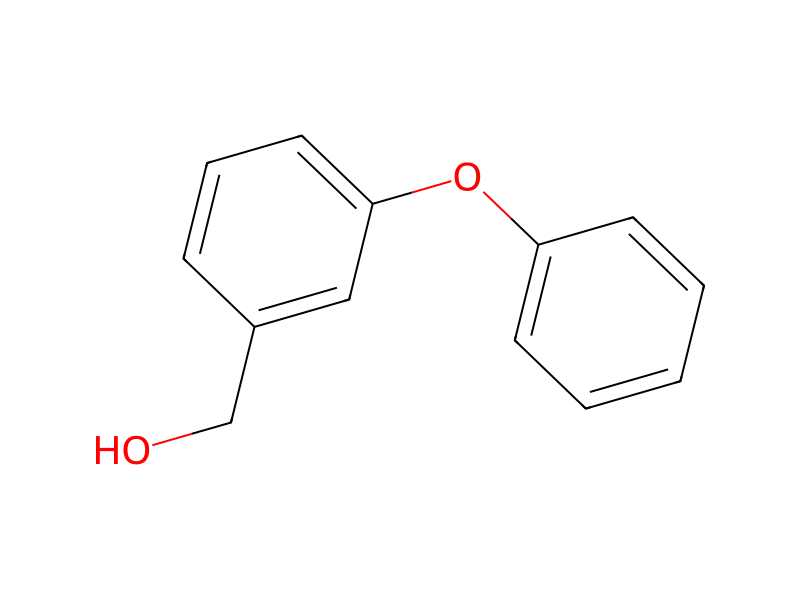

Product 1

Reagents, catalysts & solvents 2


Conditions
- Temperature
- 45 °C
Procedure
5.28 g (0.02 mol) of 2-(2',2',2'-trichloroethyl)-3,3-dimethyl-4-chlorocyclobutan-1-one, dissolved in 25 ml of absolute dimethoxyethane, are added dropwise to a solution of 4.0 g (0.02 mol) of m-phenoxybenzyl alcohol, 0.5 g (0.021 mol) of NaH and 40 ml of absolute dimethoxyethane. The reaction mixture is then stirred for 1 hour at 45° C., 2.25 g (0.02 mol) of potassium tert.-butylate are then added and the mixture is refluxed for 3 hours. After it has been discharged into water, it is acidified with dilute hydrochloric acid and extracted with benzene. The evaporated extract is chromatographed on silica gel using diethyl ether/n-hexane as the eluant (1:4 mixture by volume). This gives the m-phenoxybenzyl ester of 2-(2',2'-dichlorovinyl)-3,3-dimethylcyclopropane-1-carboxylic acid in the form of a viscous oil, which has the same properties as the substance obtained according to (a).
Workup
- temperaturethe mixture is refluxed for 3 hours
- extractionextracted with benzene
- extractionThe evaporated extract
- customis chromatographed on silica gel
Sources & evidence
- ORD record
- ord-295c5fd3b65848c9ac035f71ccbfb258
- Source dataset
- uspto-grants-1980_12
- Patent number
- US04242278
Reaction notes
Loading…