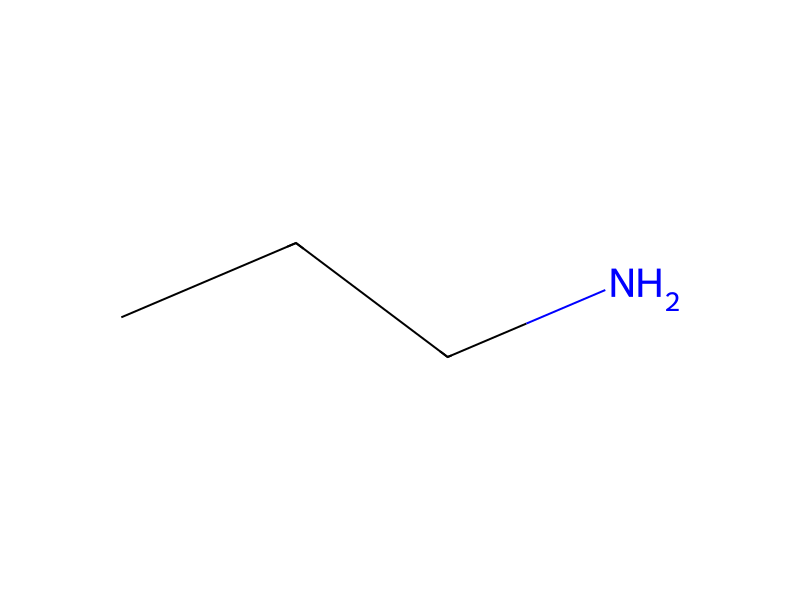
Propylamine → HCID 19917483, compound
Reaction equation

[CH2:1]([NH2:4])[CH2:2][CH3:3].[Cl:5][CH:6]=[CH:7][CH2:8]Cl.C1(P(C2C=CC=CC=2)C2C=CC=CC=2)C=CC=CC=1.[C:29]([C:33]#[CH:34])([CH3:32])([CH3:31])[CH3:30]>O1CCCC1.[Cu]I.[Pd](Cl)Cl>[ClH:5].[CH3:30][C:29]([CH3:32])([CH3:31])[C:33]#[C:34]/[CH:3]=[CH:2]/[CH2:1][NH:4][CH2:6][CH2:7][CH3:8]Participants
Reactant 4



Product 1

Reagents, catalysts & solvents 3



Procedure
To a solution of 100 ml (1.21 mol) of n-propylamine in 170 ml of tetrahydrofuran was added 18.2 ml (0.198 mol) of 1,3-dichloropropene (E/Z=9/1) under ice cooling. The solution was stirred for 2 hours, and 1.90 g (0.01 mol) of copper (I) iodide, 709 mg (4.0 mmol) of palladium chloride, 2.10 g (8.0 mmol) of triphenylphosphine and 29.3 ml (0.238 mol) of tert-butylacetylene were added to the solution under ice cooling. The mixture was stirred for 20 hours at room temperature, and extracted with a mixture of 100 ml of ethyl acetate and 100 ml of water. The organic layer was washed with 100 ml of water. The aqueous layers were combined and extracted with 20 ml of ethyl acetate. A mixture of 200 ml of water and 6N hydrochloric acid was then added to the combined organic layers to adjust to pH 2. The aqueous layer was separated. The organic layer was extracted with 50 ml and 20 ml of water. The aqueous layers were combined, and washed with a mixture of 50 ml of ethyl acetate and 20 ml of n-hexane. The aqueous layer was treated with 200 ml of dichloromethane and then adjusted to pH 9 with 6N sodium hydroxide aqueous solution. The organic layer was separated and the aqueous layer was extracted with 20 ml of dichloromethane. The combined organic layers were washed with 50 ml of a saturated aqueous solution of sodium chloride and dried over anhydrous magnesium sulfate, and treated with 17% isopropylalcohol solution of hydrogen chloride. The solvent and excess hydrogen chloride were distilled off under reduced pressure to crystallize. The crystalline residue was suspended with a mixture of 30 ml of ethyl acetate and 50 ml of n-hexane. The crystals were collected by filtration and then dried under reduced pressure to obtain 25.0 g (yield: 59%) of the above identified compound as slightly yellowish brown crystalline powder.
Workup
- stirringThe mixture was stirred for 20 hours at room temperature
- extractionextracted with a mixture of 100 ml of ethyl acetate and 100 ml of water
- washThe organic layer was washed with 100 ml of water
- extractionextracted with 20 ml of ethyl acetate
- additionA mixture of 200 ml of water and 6N hydrochloric acid
- additionwas then added to the combined organic layers
- customThe aqueous layer was separated
- extractionThe organic layer was extracted with 50 ml and 20 ml of water
- washwashed with a mixture of 50 ml of ethyl acetate and 20 ml of n-hexane
- additionThe aqueous layer was treated with 200 ml of dichloromethane
- customThe organic layer was separated
- extractionthe aqueous layer was extracted with 20 ml of dichloromethane
- washThe combined organic layers were washed with 50 ml of a saturated aqueous solution of sodium chloride
- dry with materialdried over anhydrous magnesium sulfate
- additiontreated with 17% isopropylalcohol solution of hydrogen chloride
- distillationThe solvent and excess hydrogen chloride were distilled off under reduced pressure
- customto crystallize
- additionThe crystalline residue was suspended with a mixture of 30 ml of ethyl acetate and 50 ml of n-hexane
- filtrationThe crystals were collected by filtration
- customdried under reduced pressure
- customto obtain 25.0 g (yield: 59%) of the
Sources & evidence
- ORD record
- ord-ad7b80ce4b19468b8f35177de18505de
- Source dataset
- uspto-grants-1995_08
- Patent number
- US05440049
Reaction notes
Loading…