4-Hydroxybiphenyl → 4-(Biphenyl-4-yloxymethyl)-5-methyl-furan-2-carbonitrile
Reaction equation

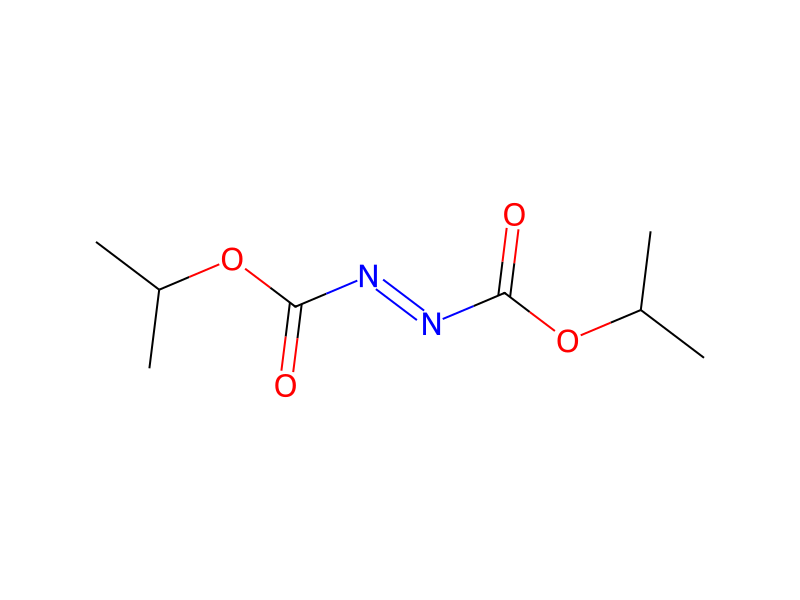
CC(OC(/N=N/C(OC(C)C)=O)=O)C.[OH:15][CH2:16][C:17]1[CH:18]=[C:19]([C:23]#[N:24])[O:20][C:21]=1[CH3:22].[C:25]1([C:32]2[CH:37]=[CH:36][CH:35]=[CH:34][CH:33]=2)[CH:30]=[CH:29][C:28](O)=[CH:27][CH:26]=1.C1(P(C2C=CC=CC=2)C2C=CC=CC=2)C=CC=CC=1>O1CCCC1>[C:25]1([C:32]2[CH:33]=[CH:34][CH:35]=[CH:36][CH:37]=2)[CH:30]=[CH:29][C:28]([O:15][CH2:16][C:17]2[CH:18]=[C:19]([C:23]#[N:24])[O:20][C:21]=2[CH3:22])=[CH:27][CH:26]=1Participants
Reactant 4



Product 1

Reagents, catalysts & solvents 1

Conditions
- Temperature
- 0 °C
Procedure
Diisopropylazodicarboxylate (1.84 g, 10.6 mmoles) was added to a solution of 4-hydroxymethyl-5-methyl-furan-2-carbonitrile (147) (1.32 g, 9.6 mmoles), biphenyl-4-ol (1.63 g, 9.6 mmoles) and triphenylphosphine (4.3 g, 16.35 mmoles) in tetrahydrofuran (50 mL) with stirring and cooling to 0° C. under an argon atmosphere. After 5 minutes, the cooling was removed and the mixture stirred at room temperature for 16 h. The solvent was evaporated and the residue partitioned between ethyl acetate and water. The ethyl acetate phase was washed with brine and dried. After the solvent was evaporated, the residue was purified by flash chromatography (silica, gradient elution with 5% to 10% ethyl acetate in cyclohexane) to afford compound 148 as a white solid (2.2 g). IR (powder) CN st. 2225 cm−1.
Workup
- customthe cooling was removed
- stirringthe mixture stirred at room temperature for 16 h
- customThe solvent was evaporated
- customthe residue partitioned between ethyl acetate and water
- washThe ethyl acetate phase was washed with brine
- customdried
- customAfter the solvent was evaporated
- customthe residue was purified by flash chromatography (silica, gradient elution with 5% to 10% ethyl acetate in cyclohexane)
Sources & evidence
- ORD record
- ord-27f5cc3427694e1da2beab85727cff68
- Source dataset
- uspto-grants-2009_03
- Patent number
- US07507754B2
Reaction notes
Loading…