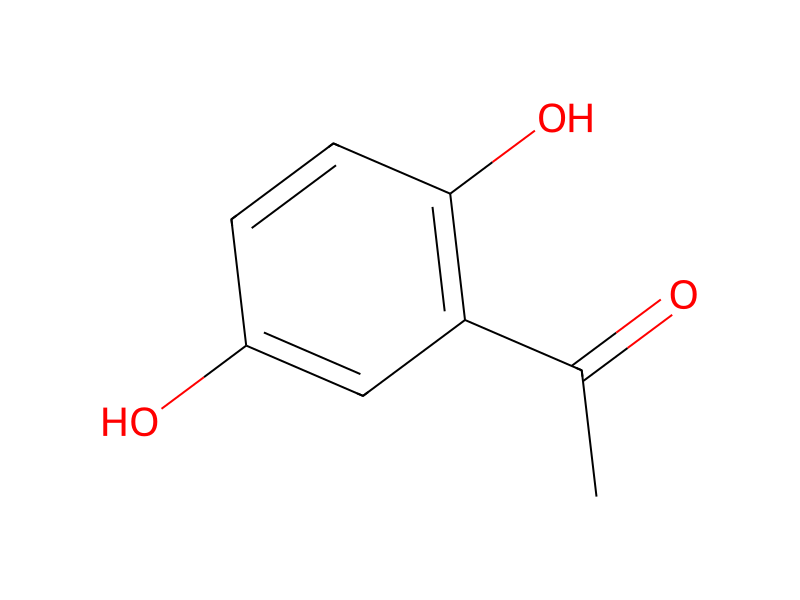
2-Acetylhydroquinone → 1-(2-Hydroxy-5-propoxyphenyl)ethan-1-one
Reaction equation

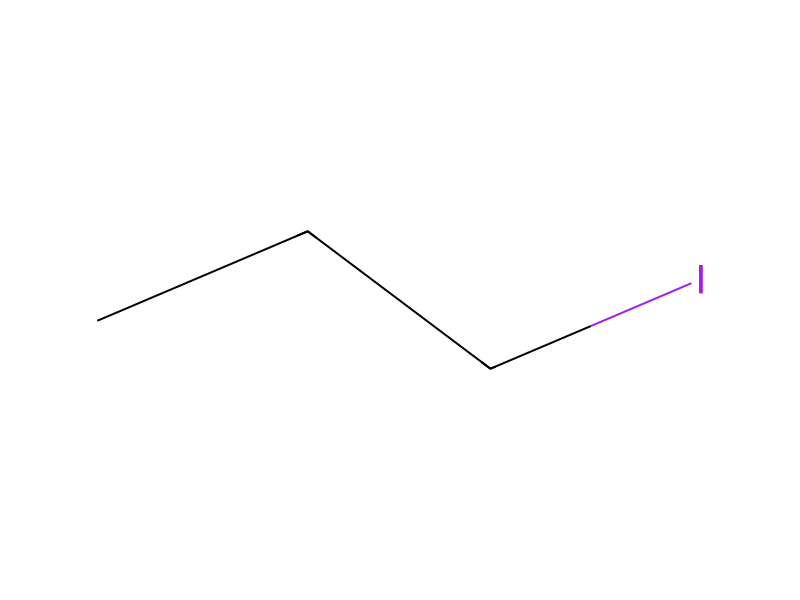
[CH3:1][C:2]([C:4]1[CH:9]=[C:8]([OH:10])[CH:7]=[CH:6][C:5]=1[OH:11])=[O:3].C([O-])([O-])=O.[K+].[K+].[CH2:18](I)[CH2:19][CH3:20]>CC(C)=O.CCOC(C)=O.C(Cl)(Cl)Cl>[OH:11][C:5]1[CH:6]=[CH:7][C:8]([O:10][CH2:18][CH2:19][CH3:20])=[CH:9][C:4]=1[C:2](=[O:3])[CH3:1]Participants





Procedure
10 g of 2,5-dihydroxyacetophenone suspended in 100 mL of acetone are placed in a 500 mL round-bottomed flask and 9.14 g of anhydrous K2CO3 are added, followed by addition of 12.4 g of propyl iodide. The reaction medium is refluxed for 30 hours. After cooling to room temperature, the medium is filtered through Celite® and then concentrated. The brown oil obtained is taken up in EtOAc, filtered, washed with water, with 2 M HCl solution and then with saturated NaCl solution. The organic phase is evaporated to give a black paste. The paste is taken up in chloroform and filtered. The medium is concentrated to give 11.4 g of a black solid. This solid is taken up in absolute ethanol. The solution is placed in a freezer for 10 minutes, and a solid precipitates and is collected by filtration. The filtrate is concentrated, taken up in ethanol, cooled in the freezer and then filtered again. This operation is repeated 4 times to give 8.35 g of the expected compound in the form of a powder.
Workup
- customare placed in a 500 mL round-bottomed flask
- temperatureThe reaction medium is refluxed for 30 hours
- filtrationthe medium is filtered through Celite®
- concentrationconcentrated
- customThe brown oil obtained
- filtrationfiltered
- washwashed with water, with 2 M HCl solution
- customThe organic phase is evaporated
- customto give a black paste
- filtrationfiltered
- concentrationThe medium is concentrated
Sources & evidence
- ORD record
- ord-e02c54459ada41589eef9eeac3215673
- Source dataset
- uspto-grants-2009_10
- Patent number
- US07598392B2
Reaction notes
Loading…