Dimethylformamide → 4-Chloropyridine-3-carbaldehyde
Reaction equation

C([N-]C(C)C)(C)C.[Li+].C([Li])CCC.C(NC(C)C)(C)C.Cl.[Cl:22][C:23]1[CH:28]=[CH:27][N:26]=[CH:25][CH:24]=1.CN(C)[CH:31]=[O:32]>O1CCCC1.O>[Cl:22][C:23]1[CH:28]=[CH:27][N:26]=[CH:25][C:24]=1[CH:31]=[O:32]Participants


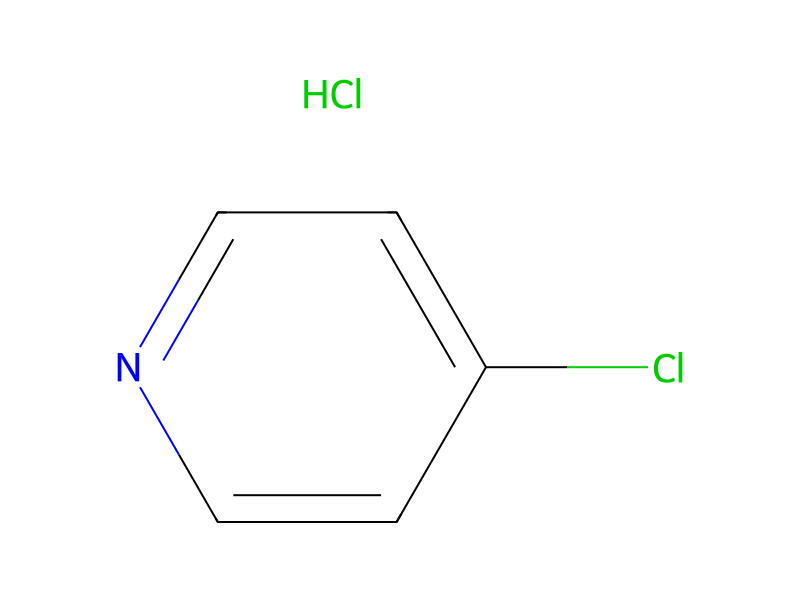





Conditions
- Temperature
- -60 °C
Procedure
Form a solution of lithium diisopropylamide by the adding n-butyl lithium (37.5 mL, 0.06 mol, 1.6 M in hexanes) to diisopropylamine (8.40 mL, 0.06 mol) in tetrahydrofuran (200 mL) at −10 to −20° C. under a nitrogen atmosphere. Stir for 30 min., and cool to −60° C. Add 4-chloropyridine hydrochloride (3.75 g, 0.025 mol) in small portions and stir for 1.5 hours at this temperature. Add dimethylformamide (4.0 mL, 0.052 mol) dropwise via syringe and stir for 1 hour near −60° C. Add water (200 mL) when the mixture has warmed near 0° C. Extract with ethyl acetate. Dry the combined extracts over sodium sulfate and concentrate in vacuo. Elute the resulting residue over silica with methanol/dichloromethane, allowing for isolation of the desired aldehyde (2.80 g, 79%) as a light yellowish solid. MS(BI): (M)+ 141.0, 142.0, 143.0 m/z.
Workup
- customat −10 to −20° C.
- extractionExtract with ethyl acetate
- dry with materialDry the combined extracts over sodium sulfate
- concentrationconcentrate in vacuo
- washElute the resulting residue over silica with methanol/dichloromethane
Sources & evidence
- ORD record
- ord-21595ccdfbb045b69cd00539fee6c9dd
- Source dataset
- uspto-grants-2006_05
- Patent number
- US07037921B2
Reaction notes
Loading…