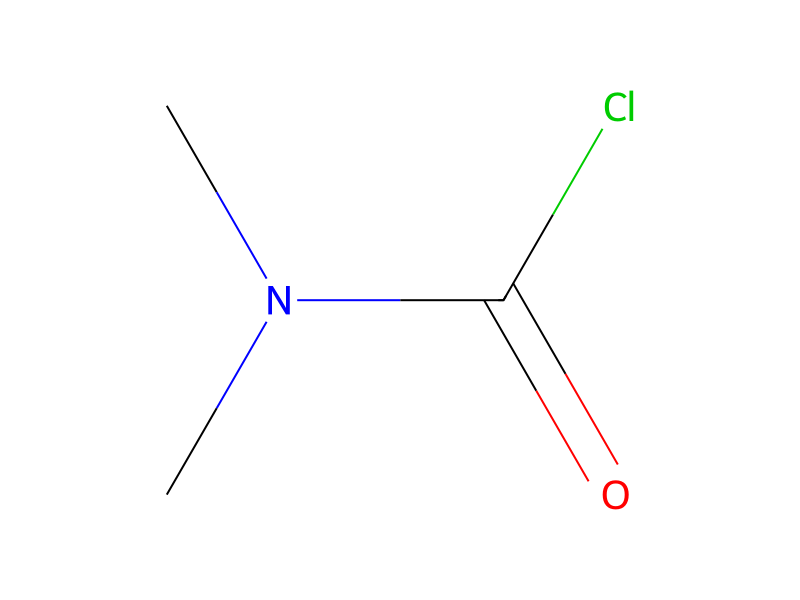
Dimethylcarbamoyl Chloride → HCID 60161671, compound
Reaction equation

[CH2:1]([N:4]1[C:13]2[C:8](=[CH:9][CH:10]=[C:11]([OH:14])[CH:12]=2)[CH2:7][CH2:6][CH2:5]1)[C:2]#[CH:3].[H-].[Na+].[CH3:17][N:18]([CH3:22])[C:19](Cl)=[O:20]>O1CCCC1.C(OCC)(=O)C>[CH3:17][N:18]([CH3:22])[C:19](=[O:20])[O:14][C:11]1[CH:12]=[C:13]2[C:8]([CH2:7][CH2:6][CH2:5][N:4]2[CH2:1][C:2]#[CH:3])=[CH:9][CH:10]=1Participants
Reactant 3


Product 1

Reagents, catalysts & solvents 2


Procedure
A solution of 1-(prop-2-ynyl)-1,2,3,4-tetrahydroquinolin-7-ol (400 mg, 2.14 mM) in dry tetrahydrofuran (THF; 5 mL) was added to the stirred solution of sodium hydride in dry THF at −10° C. during 5 minutes under nitrogen environment at room temperature (25° C.). The reaction mixture was stirred for 30 minutes. Then, N,N-dimethyl carbamoyl chloride (0.25 mL) was added to the stirring reaction mixture. The mixture was stirred further for 7 hours during which the temperature was allowed to reach the room temperature (35° C.). The reaction mixture was diluted with ethyl acetate, washed with water, and dried over sodium sulphate. The combined fractions of ethyl acetate were concentrated under vacuum and chromatographed using ethyl acetate:hexane (1:49) to afford 10g as solid. Yield: 414 mg, 75.6%.
Workup
- stirringThe mixture was stirred further for 7 hours during which the temperature
- customthe room temperature (35° C.)
- washwashed with water
- dry with materialdried over sodium sulphate
- concentrationThe combined fractions of ethyl acetate were concentrated under vacuum
- customchromatographed
Sources & evidence
- ORD record
- ord-0669710639a24c9c969fc68f68cfa57b
- Source dataset
- uspto-grants-2015_02
- Patent number
- US08946261B2
Reaction notes
Loading…