p-Fluoronitrobenzene → 1-Fluoro-2-(4-nitrophenoxy)benzene
Reaction equation

[F:1][C:2]1[CH:7]=[CH:6][CH:5]=[CH:4][C:3]=1[OH:8].[H-].[Na+].F[C:12]1[CH:17]=[CH:16][C:15]([N+:18]([O-:20])=[O:19])=[CH:14][CH:13]=1>CN(C)C=O.Cl[Cu]>[F:1][C:2]1[CH:7]=[CH:6][CH:5]=[CH:4][C:3]=1[O:8][C:12]1[CH:17]=[CH:16][C:15]([N+:18]([O-:20])=[O:19])=[CH:14][CH:13]=1Participants
Reactant 3
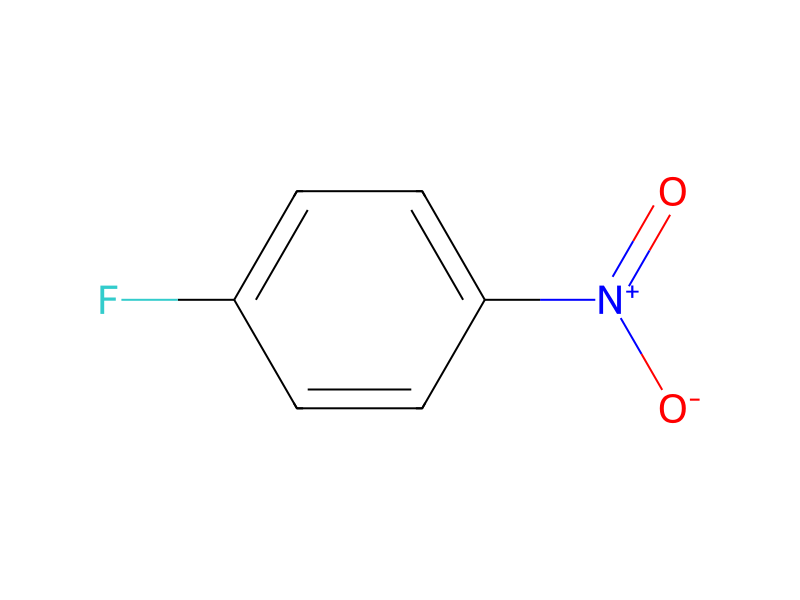


Product 1

Reagents, catalysts & solvents 2


Conditions
- Temperature
- 100 °C
Procedure
Into a 100 mL 3-necked round-bottom flask, was placed a solution of 2-fluorophenol (2.6 g, 23.19 mmol, 1.00 equiv) in N,N-dimethylformamide (30 mL) and CuCl (2.2 g, 2.41 equiv). This was followed by the addition of sodium hydride (1.34 g, 55.83 mmol, 0.86 equiv) in portions and then 1-fluoro-4-nitrobenzene (2.8 g, 19.84 mmol, 0.67 equiv). The resulting solution was stirred for 5 h at 100° C. in an oil bath and the resulting solution was diluted with water/ice. The aqueous mixture was extracted with ethyl acetate and the organic layers combined and dried over anhydrous sodium sulfate, and concentrated under vacuum. The residue was loaded onto a silica gel column and elution with ethyl acetate/petroleum ether (1:100) gave 1.7 g (31%) of 1-(2-fluorophenoxy)-4-nitrobenzene as a light yellow solid.
Workup
- customInto a 100 mL 3-necked round-bottom flask, was placed
- extractionThe aqueous mixture was extracted with ethyl acetate
- dry with materialdried over anhydrous sodium sulfate
- concentrationconcentrated under vacuum
- washThe residue was loaded onto a silica gel column and elution with ethyl acetate/petroleum ether (1:100)
Sources & evidence
- ORD record
- ord-b3dbb8d8539d4a479c1862f9a82fc186
- Source dataset
- uspto-grants-2015_02
- Patent number
- US08962635B2
Reaction notes
Loading…