1-Naphthol → HCID 131727825, compound
Reaction equation

[CH:1]1[CH:2]=[CH:3][C:4]2[C:5](=[CH:7][CH:8]=[CH:9][C:10]=2[OH:11])[CH:6]=1.[Si:12](Cl)(C(C)(C)C)(C)C.[Si](Cl)(C(C)(C)C)(C1C=CC=CC=1)C1C=CC=CC=1.CCN(C(C)C)C(C)C>C(Cl)Cl.CN(C=O)C.C1COCC1.C(#N)C>[SiH3:12][O:11][C:10]1[C:4]2[C:5](=[CH:6][CH:1]=[CH:2][CH:3]=2)[CH:7]=[CH:8][CH:9]=1Participants
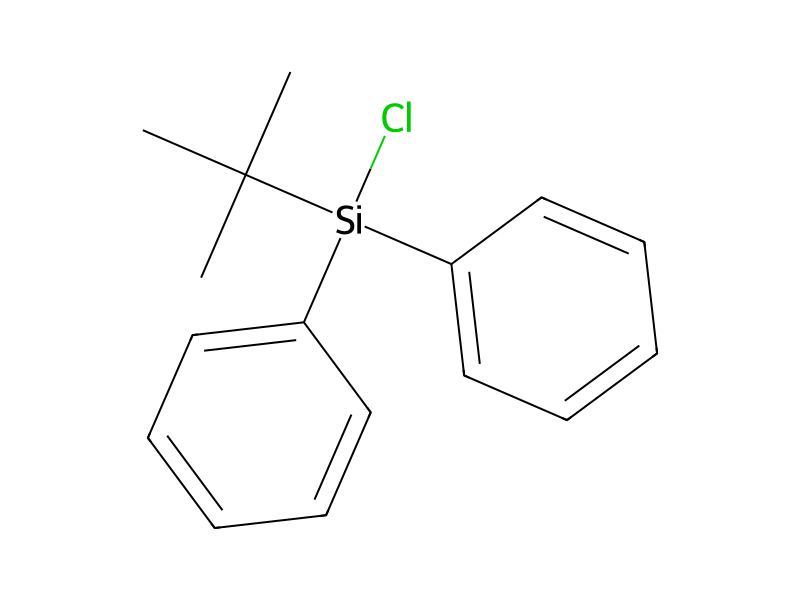
Reactant 4



Product 1

Reagents, catalysts & solvents 4




Conditions
- Temperature
- 0 °C
Procedure
Naphthols 3a, 12 (18.7 mmol) was dissolved in dry DCM (100 mL) and cooled to 0° C. under N2 atm. Either TBDMS chloride or TBDPS chloride (20.5 mmol) was then added and the mixture stirred 5 minutes at 0° C. (Note: ACN, THF, and DMF can also be used as solvents or co-solvents). DIEA (28.0 mmol) was then added by syringe over 15 minutes and the resulting mixture was allowed to warm to rt overnight. (Note: Heat was required to drive the reaction when TBDPS chloride was used; reactions were monitored by TLC). Upon completion, the crude reaction mixture was washed with DI water and the organics dried over anhydrous Na2SO4, filtered, and the solvent removed under vacuum. Purification of the resulting residue by column chromatography on silica gel with 9:1 hexanes:EtOAc afforded silyl ether 109 in 76-96% yield.
Workup
- temperatureto warm to rt overnight
- temperature(Note: Heat
- customUpon completion, the crude reaction mixture
- washwas washed with DI water
- dry with materialthe organics dried over anhydrous Na2SO4
- filtrationfiltered
- customthe solvent removed under vacuum
- customPurification of the resulting residue by column chromatography on silica gel with 9:1 hexanes
Sources & evidence
- ORD record
- ord-f6b71fc55fed4c95a2ad070dd94eb5a7
- Source dataset
- uspto-grants-2009_12
- Patent number
- US07632828B2
Reaction notes
Loading…