4-Methylmorpholine → HCID 178508884, compound
Reaction equation

Cl.[NH2:2][C:3]1[N:4]=[C:5]([OH:24])[C:6]2[CH2:12][CH:11]([CH2:13][CH2:14][C:15]3[CH:23]=[CH:22][C:18]([C:19](O)=[O:20])=[CH:17][CH:16]=3)[CH2:10][NH:9][C:7]=2[N:8]=1.CN1CCOCC1.ClC1N=C(OC)N=C(OC)N=1.[NH2:43][C:44]1([C:51]([OH:53])=[O:52])[CH2:49][CH:48]2[CH2:50][CH:45]1[CH2:46][CH2:47]2.[NH4+].CC(C([O-])=O)CCCCC.[K+].[Br-].[OH-].[Na+]>CN(C)C=O>[NH4+:2].[NH2:2][C:3]1[N:4]=[C:5]([OH:24])[C:6]2[CH2:12][CH:11]([CH2:13][CH2:14][C:15]3[CH:23]=[CH:22][C:18]([C:19]([NH:43][C:44]4([C:51]([O-:53])=[O:52])[CH2:49][CH:48]5[CH2:50][CH:45]4[CH2:46][CH2:47]5)=[O:20])=[CH:17][CH:16]=3)[CH2:10][NH:9][C:7]=2[N:8]=1Participants
Reactant 7





Product 1

Reagents, catalysts & solvents 1

Procedure
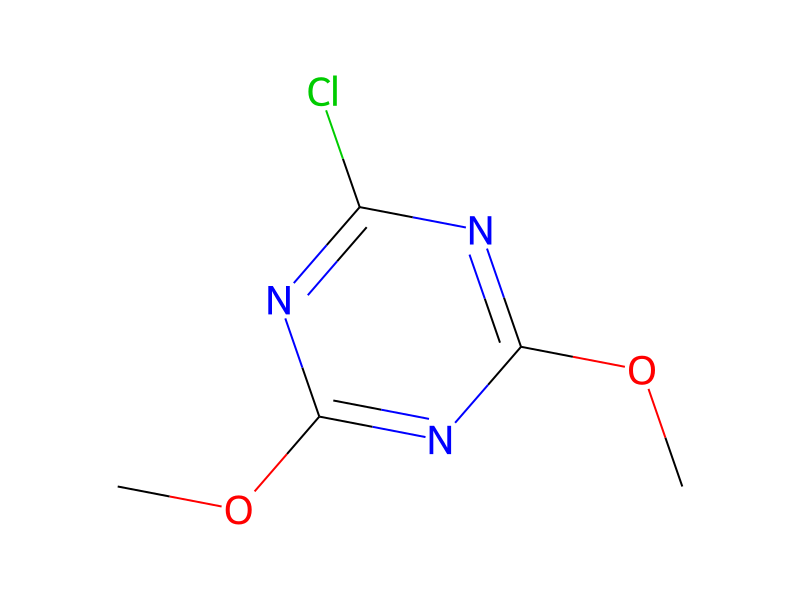
After flame drying a 15-mL two-neck round bottom flask under argon, 0.20 g (0.57 mmol) of 4-[2-(2-amino-4-hydroxy-5,6,7,8-tetrahydropyrido[2,3-d]pyrimidin-6-yl)ethyl]-benzoic acid hydrochloride was suspended in 2 mL of anhydrous N,N-dimethylformamide, followed by the addition of 0.19 mL (1.7 mmol) of 4-methylmorpholine. After stirring the reaction at room temperature for 15 minutes, 0.15 g (0.86 mmol) of 2-chloro-4,6-dimethoxy-1,3,5-triazine was added. The reaction was stirred at room temperature for 30 minutes and 0.134 g (0.86 mmol) of 2-aminonorbornane-2-carboxylic acid was added. The reaction mixture was stirred at room temperature for 3 hours. The volatiles were concentrated in vacuo, and the residue was treated with 50 mL of H20, and the white solid was filtered and dried in a vacuum oven at 60° C. The crude solid was purified using rotor chromatography on a 2 mm Chromatotron® silica gel plate, and eluted with a gradient of 20% CH3OH/CHCl3 to 75:25:1 CHCl3 /CH3OH/NH4OH. The correct fractions were combined and removed in vacuo to give 0.025 g (9%) of 2-{4-[2-(2-amino-4-hydroxy-5,6,7,8-tetrahydropyrido[2,3-d]pyrimidin-6-yl)ethyl]benzoylamino}bicyclo[2.2.]heptane-2-carboxylic acid ammonium salt as a white solid. Rf=0.30 (6/3.2/0.8) (CHCl3 /CH3OH/NH4OH); m.p. 241° C. (foam); IR (KBr, cm-1)=615, 647, 772, 1019, 1121, 1218, 1307, 1370, 1477, 1538, 1641, 2952, 3344; UV (0.1N NaOH) λmax =273, 241, 218 (ε=9839, 14408, 21458); Exact mass: Calcd=452.2298; Found=452.2338 5; 1H NMR (300 MHz, DMSOd6) δ1.26-1.37 (m, 2H), 1.48-1.81 (m, 7H), 1.84-1.88 (m, 4H), 2.63-2.83 (m, 4H), 3.19-3.27 (m, 2H), 5.97 (s, 2H), 6.27 (S, 1H), 7.31 (d, J=8.1 Hz, 2H), 7.78 (d, J=7.9 Hz, 2H), 8.53 (s, 1H).
Workup
- temperatureAfter flame
- customdrying a 15-mL two-neck round bottom flask under argon
- customthe reaction at room temperature for 15 minutes
- stirringThe reaction was stirred at room temperature for 30 minutes
- stirringThe reaction mixture was stirred at room temperature for 3 hours
- concentrationThe volatiles were concentrated in vacuo
- additionthe residue was treated with 50 mL of H20
- filtrationthe white solid was filtered
- customdried in a vacuum oven at 60° C
- customThe crude solid was purified
- washeluted with a gradient of 20% CH3OH/CHCl3 to 75:25:1 CHCl3 /CH3OH/NH4OH
- customremoved in vacuo
- customto give 0.025 g (9%) of 2-{4-[2-(2-amino-4-hydroxy-5,6,7,8-tetrahydropyrido[2,3-d]pyrimidin-6-yl)ethyl]benzoylamino}bicyclo[2.2
Sources & evidence
- ORD record
- ord-103999ad3d5640f8b357c7fbc71f427e
- Source dataset
- uspto-grants-1998_07
- Patent number
- US05786358
Reaction notes
Loading…