Triphenylphosphine → HCID 21999287, compound
Reaction equation

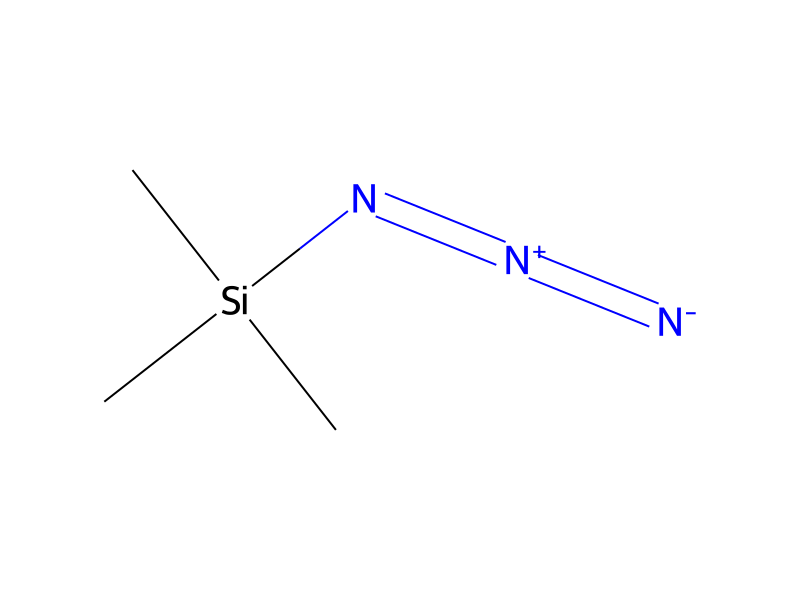
C1(P(C2C=CC=CC=2)C2C=CC=CC=2)C=CC=CC=1.N(C(OCC)=O)=NC(OCC)=[O:23].C[O:33][C:34](=[O:57])[C:35]1[CH:40]=[CH:39][C:38]([NH:41][C:42]([NH:44][CH2:45][C:46]2[CH:51]=[CH:50][CH:49]=[C:48](OC(=O)C)C=2)=O)=[CH:37][C:36]=1[Cl:56].C[Si]([N:62]=[N+:63]=[N-:64])(C)C>C1COCC1.CO.[OH-].[Li+]>[Cl:56][C:36]1[CH:37]=[C:38]([N:41]2[C:42]([NH:44][C:45]3[CH:46]=[CH:51][CH:50]=[C:49]([OH:23])[CH:48]=3)=[N:64][N:63]=[N:62]2)[CH:39]=[CH:40][C:35]=1[C:34]([OH:33])=[O:57]Participants
Reactant 4



Product 1

Reagents, catalysts & solvents 3



Procedure
In a dry argon atmosphere, a solution of triphenylphosphine (1.684 g; 6.42 mmol), diethyl azodicarboxylate (1.13 g; 6.42 mmol) and 4-[3-(3-acetoxybenzyl)ureido]-2-chlorobenzoic acid methyl ester (1.21 g; 3.21 mmol) in dry THF (30 mL) was treated with trimethylsilyl azide (0.86 mL; 6.48 mmol) and was stirred at room temperature for 24 hr. Examination of the reaction mixture by TLC suggested the presence of considerable starting material, so additional amounts of triphenylphosphine (0.842 g; 3.21 mmol), diethyl azodicarboxylate (0.565 g; 3.21 mmol) and trimethylsilyl azide (0.43 mL; 3.21 mmol) were added. The reaction was stirred at room temperature for an additional 40 hr. After the solvents were removed under reduced pressure, the residue was taken up in dichloromethane (100 mL) and washed with water (2×50 mL). The aqueous extracts were backwashed in turn with dichloromethane (50 mL) and the combined, dried (MgSO4) extracts were evaporated in vacuo. From a previous experiment it had been established that the reaction yielded a complex, difficultly separable, mixture of several products, some deacetylated and/or de-esterified. Accordingly, in this experiment, the residue was dissolved in a mixture of methanol (30 mL) and 1N lithium hydroxide (15 mL) and the mixture was stirred at room temperature for 2 hr to complete the hydrolyses of both the ester and phenolic acetate groups. Most of the volatiles were removed under reduced pressure then the basic solution was diluted with water (20 mL) and washed with dichloromethane (2×30 mL). The aqueous layer was then acidified with 1N HCl (16 mL) and extracted with ethyl acetate (2×50 mL). The dried (MgSO4) ethyl acetate extracts were evaporated and the residual solid (810 mg), approximately a 4:1 mixture of the desired aminotetrazole and its positional isomer, was crystallized from ether to furnish 560 mg of 2-chloro-4-[5-[(3-hydroxyphenyl)amino]tetrazol-1-yl]benzoic acid as a colorless solid. FAB HRMS: (C15H12ClN5O3) Obs. Mass 345.0624 Calcd. Mass 345.0629 (M+H).
Workup
- additionwere added
- stirringThe reaction was stirred at room temperature for an additional 40 hr
- customAfter the solvents were removed under reduced pressure
- washwashed with water (2×50 mL)
- dry with materialdried (MgSO4) extracts
- customwere evaporated in vacuo
- customyielded a complex
- additiondifficultly separable, mixture of several products
- stirringthe mixture was stirred at room temperature for 2 hr
- customMost of the volatiles were removed under reduced pressure
- additionthe basic solution was diluted with water (20 mL)
- washwashed with dichloromethane (2×30 mL)
- extractionextracted with ethyl acetate (2×50 mL)
- dry with materialThe dried (MgSO4) ethyl acetate extracts
- customwere evaporated
- additionthe residual solid (810 mg), approximately a 4:1 mixture of the desired aminotetrazole and its positional isomer
- customwas crystallized from ether
Sources & evidence
- ORD record
- ord-4076350a3e2c4bf1b28c9421dbb73862
- Source dataset
- uspto-grants-2001_05
- Patent number
- US06229011B1
Reaction notes
Loading…