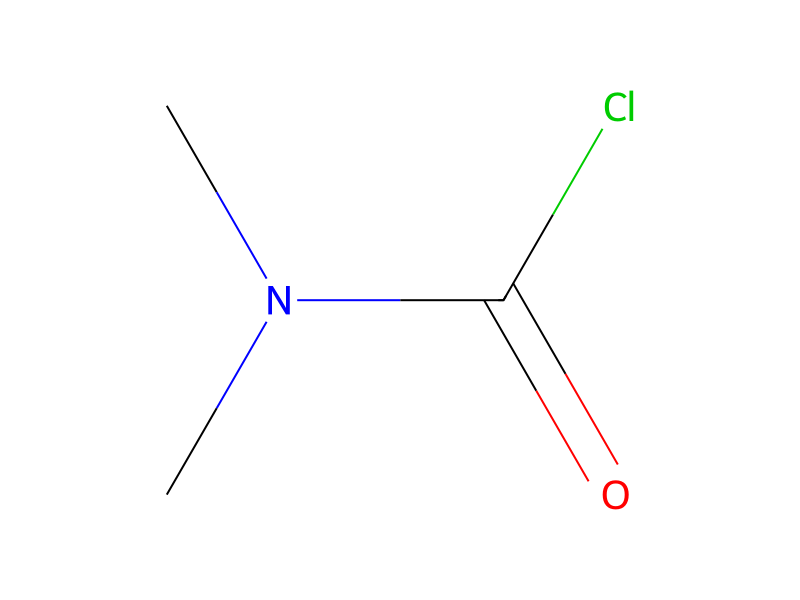
Dimethylcarbamoyl Chloride → HCID 15017030, compound
Reaction equation

Br.Br.[C:3]([C:7]1[N:11]=[C:10]([S:12][CH2:13][CH2:14][NH2:15])[NH:9][N:8]=1)([CH3:6])([CH3:5])[CH3:4].[CH3:16][N:17]([CH3:21])[C:18](Cl)=[O:19].[CH2:22]([N:24]([CH2:27]C)[CH2:25]C)C.C1C[O:32]CC1>CN(C)C1C=CN=CC=1>[CH3:16][N:17]([CH3:21])[C:18]([N:9]1[C:10]([S:12][CH2:13][CH2:14][NH:15][C:22](=[O:32])[N:24]([CH3:27])[CH3:25])=[N:11][C:7]([C:3]([CH3:6])([CH3:4])[CH3:5])=[N:8]1)=[O:19]Participants
6
Reactant 4



Product 1

Reagents, catalysts & solvents 1

Procedure
To 10 g (27 mmole) of 3-t-butyl-5-(2-aminoethylthio)-1H-1,2,4-triazole dihydrobromide in 50 ml of THF was added 0.5 g of 4-dimethylaminopyridine and 6 g (54 mmole) of dimethylcarbamoyl chloride and the mixture was stirred at room temperature for five minutes. Then 10 g of triethylamine was added dropwise and the mixture was refluxed for five minutes then stirred overnight at room temperature. Workup essentially as in Example 1, Step B, followed by crystallization from ether-hexane yielded 1-dimethylcarbamoyl-3-t-butyl-5-(2-(dimethylcarbamoylamino)-ethylthio)-1H-1,2,4-triazole, m.p. 82-83.
Workup
- temperaturethe mixture was refluxed for five minutes
- stirringthen stirred overnight at room temperature
- customWorkup essentially as in Example 1, Step B, followed by crystallization from ether-hexane
Sources & evidence
- ORD record
- ord-19c85dbf9065433d92732b59ce14cb8e
- Source dataset
- uspto-grants-1991_05
- Patent number
- US05015652
Reaction notes
Loading…