Sodium Iodide → 6-bromo-8-methoxy-4H-benzo[1,3]dioxine
Reaction equation

[Br:1][C:2]1[CH:7]=[C:6]([O:8][CH3:9])[C:5]([OH:10])=[C:4]([CH2:11][OH:12])[CH:3]=1.[H-].[Na+].Br[CH2:16]Cl.[I-].[Na+].[Cl-].[NH4+]>CN(C=O)C.C(OCC)(=O)C>[Br:1][C:2]1[CH:7]=[C:6]([O:8][CH3:9])[C:5]2[O:10][CH2:16][O:12][CH2:11][C:4]=2[CH:3]=1Participants
Reactant 5




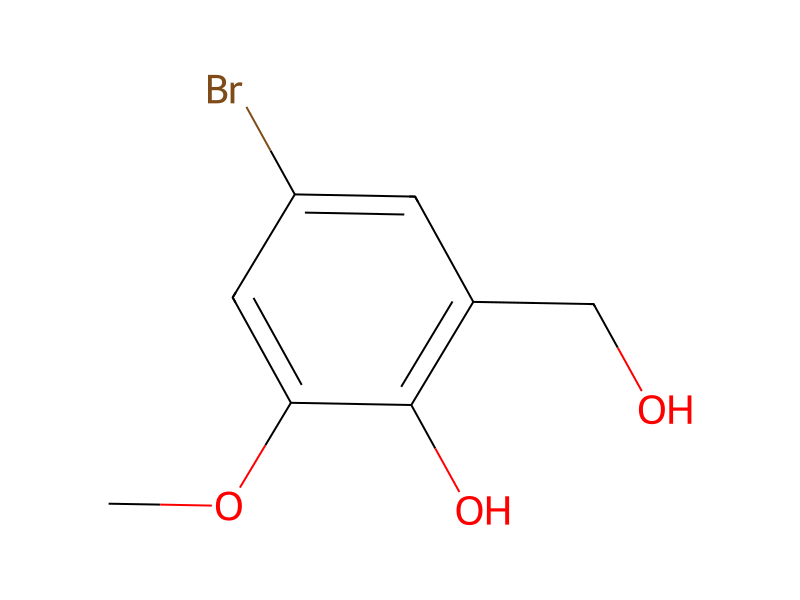
Product 1

Reagents, catalysts & solvents 2


Procedure
To a solution of the 50g of 4-bromo-2-hydroxymethyl-6-methoxyphenol in 450 ml of DMF there was added 20g of sodium hydride (60% oily suspension) while cooling on ice, and the mixture was stirred at room temperature for 30 minutes. After adding 15 ml of bromochloromethane and 3.2 g of sodium iodide to the reaction mixture, it was stirred at 80° C. for 6 hours under a nitrogen atmosphere. Saturated aqueous ammonium chloride was added to the reaction mixture, and extraction was performed with ethyl acetate. The organic layer was dried over anhydrous magnesium sulfate. The desiccating agent was filtered off and the filtrate was concentrated under reduced pressure. The residue was purified by silica gel column chromatography (ethyl acetate-heptane) to give the title compound (31.2 g) as a white solid.
Workup
- temperaturewhile cooling on ice
- stirringwas stirred at 80° C. for 6 hours under a nitrogen atmosphere
- dry with materialThe organic layer was dried over anhydrous magnesium sulfate
- filtrationThe desiccating agent was filtered off
- concentrationthe filtrate was concentrated under reduced pressure
- customThe residue was purified by silica gel column chromatography (ethyl acetate-heptane)
Sources & evidence
- ORD record
- ord-4b76a36dd3ae434b96faf25f47594fd0
- Source dataset
- uspto-grants-2011_04
- Patent number
- US07928228B2
Reaction notes
Loading…