Trifluoroacetic acid → HCID 57803064, compound
Reaction equation

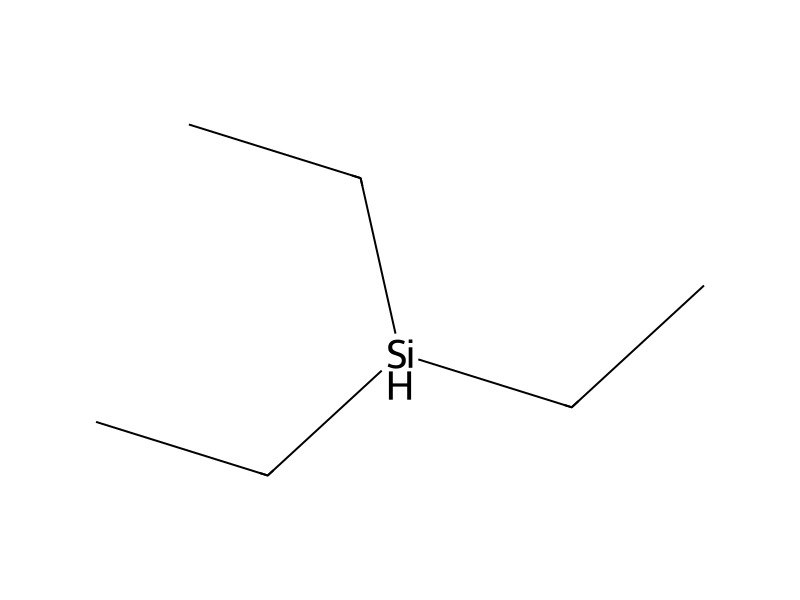
[Cl:1][C:2]1[CH:10]=[C:9]2[C:5]([C:6]([CH:13]3[CH2:17][CH2:16][CH2:15][CH2:14]3)(O)[C:7](=[O:11])[NH:8]2)=[CH:4][CH:3]=1.C([SiH](CC)CC)C.FC(F)(F)C(O)=O.C(=O)([O-])[O-].[K+].[K+]>C(OCC)(=O)C>[Cl:1][C:2]1[CH:10]=[C:9]2[C:5]([CH:6]([CH:13]3[CH2:17][CH2:16][CH2:15][CH2:14]3)[C:7](=[O:11])[NH:8]2)=[CH:4][CH:3]=1Participants
Reactant 4



Product 1

Reagents, catalysts & solvents 1

Conditions
- Temperature
- 100 °C
Procedure
A suspension of rac-6-chloro-3-cyclopentyl-3-hydroxy-1,3-dihydro-indol-2-one (1.0 g, 4 mmol) (from Example 3a, supra) in a mixture of triethylsilane (2 mL, 12.5 mmol) (Aldrich) and trifluoroacetic acid (5 mL, 65 mmol) was heated in a 100° C. bath for 48 hours. After cooling to room temperature, mixture was diluted with ethyl acetate (50 mL). Solid potassium carbonate was added and mixture stirred at room temperature for 1 hour. Mixture was filtered and concentrated. Residue was redissolved in ethyl acetate and adsorbed onto silica gel (10 g). Solvent was evaporated off. Material was purified by flash chromatography (Biotage 40 M, 5% then 10% ethyl acetate in dichloromethane as solvent). Main product fractions were collected and concentrated to give rac-6-chloro-3-cyclopentyl-1,3-dihydro-indol-2-one as a dark purple solid. (Yield 0.24 g, 25.6%).
Workup
- temperatureAfter cooling to room temperature
- filtrationMixture was filtered
- concentrationconcentrated
- dissolutionResidue was redissolved in ethyl acetate
- customSolvent was evaporated off
- customMaterial was purified by flash chromatography (Biotage 40 M, 5%
- customMain product fractions were collected
- concentrationconcentrated
Sources & evidence
- ORD record
- ord-f5bdb6f2649f422cb581ba089abdb89a
- Source dataset
- uspto-grants-2009_08
- Patent number
- US07576082B2
Reaction notes
Loading…