Triphenylphosphine → Triphenylphosphine Oxide
Reaction equation

CC([O:4]C(/N=N/C(OC(C)C)=O)=O)C.OCCC1N=CSC=1C.[C:24]1([P:30]([C:37]2[CH:42]=[CH:41][CH:40]=[CH:39][CH:38]=2)[C:31]2[CH:36]=[CH:35][CH:34]=[CH:33][CH:32]=2)[CH:29]=[CH:28][CH:27]=[CH:26][CH:25]=1>C1COCC1>[C:37]1([P:30](=[O:4])([C:24]2[CH:25]=[CH:26][CH:27]=[CH:28][CH:29]=2)[C:31]2[CH:36]=[CH:35][CH:34]=[CH:33][CH:32]=2)[CH:38]=[CH:39][CH:40]=[CH:41][CH:42]=1Participants
Reactant 3


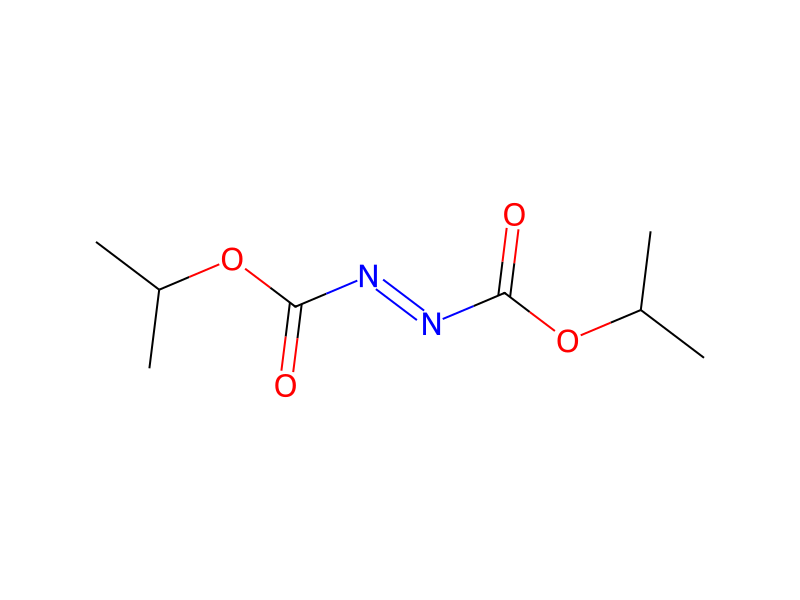
Product 1

Reagents, catalysts & solvents 1

Procedure
DIAD (3.16 ml, 16.1 mM) was added to a stirred solution of methyl 3-nitro-5-hydroxy benzoate (2.11 g, 10.7 mM), 4-(2-hydroxy ethyl)-5-methylthiazole (1.55 ml, 12.8 mM), and triphenylphosphine (4.21 g, 16.1 mM) in THF (50 ml) under an argon atmosphere at room temperature. After 1 hr reaction mixture concentrated in vacuo, residue triturated with diethyl ether to give a colourless solid (triphenylphosphine oxide). Diethyl ether conc. to give a dark brown gum, purification on silica gel (50% to 75% EtOAc/iso-hexane) gave the product contaminated with reduced DIAD and triphenylphosphine oxide (6.8 g). The crude product was dissolved/suspended in MeOH (80 ml), 2M NaOH (20 ml, 40 mM) added, heated at 65° C. for 4 hrs then cooled and concentrated. The residue was diluted with water (140 ml)/2M NaOH (40 ml), the precipitated triphenylphosphine oxide filtered, then acidified with c. HCl to pH 1-2. The precipitate was filtered, washed with water, dried under high-vacuum to give 3-{2-(4-methyl thiazol-5-yl)ethoxy}-5-nitro benzoic acid as a colourless solid (3.12 g, 79% over 2 steps); 1H NMR δ (d6-DMSO): 2.39 (s, 3H), 3.23 (t, 2H), 4.35 (t, 2H), 7.78 (s, 1H), 7.90 (m, 1H), 8.22 (s, 1H), 8.93 (s, 1H).
Workup
- customAfter 1 hr reaction mixture
- concentrationconcentrated in vacuo, residue
- customtriturated with diethyl ether
Sources & evidence
- ORD record
- ord-2281ed7685d74bfabdbcdcbbb6f4c652
- Source dataset
- uspto-grants-2009_04
- Patent number
- US07524957B2
Reaction notes
Loading…