Hydrochloric Acid → HCID 131714152, compound
Reaction equation

[CH:1]1[C:10]2[C:5](=[CH:6][CH:7]=[CH:8][CH:9]=2)[CH:4]=[CH:3][CH:2]=1.[Na:11].C1(P2C=C(C)C(C)=C2)C=CC=CC=1.[Mg+2:25].[Br-:26].[Br-].[S].Cl>C1COCC1>[CH:9]1[C:10]2[C:5](=[CH:4][CH:3]=[CH:2][CH:1]=2)[CH:6]=[CH:7][CH:8]=1.[Na:11].[Mg+2:25].[Br-:26].[Br-:26]Participants






Conditions
- Temperature
- 70 °C
Procedure
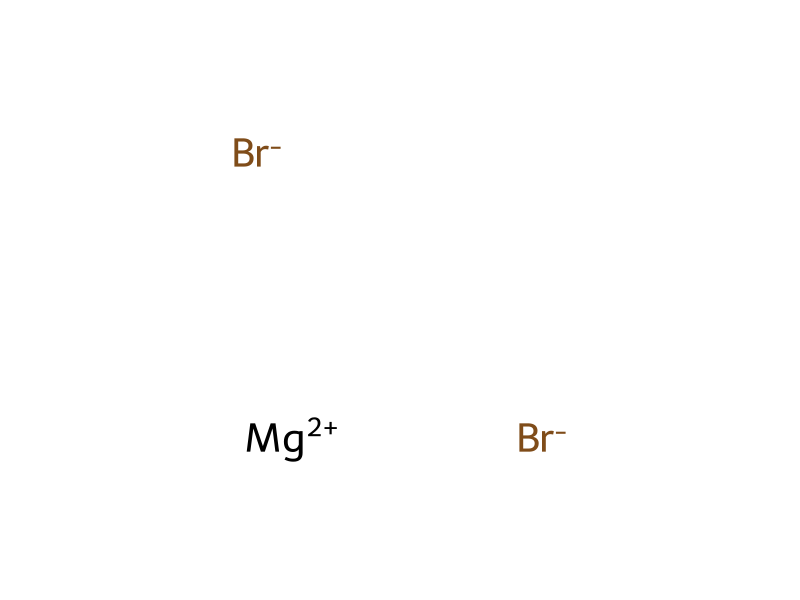
In a well dried Erlenmeyer flask 6 g of naphthalene (0.047 mole) were dissolved in 100 cm3 of THF. 1 g of sodium (0.043 at-g) cut into small pieces was added. When all the sodium had reacted (about 1 hour), 4 cm3 of 1-phenyl-3,4-dimethyl phosphole (0.0213 mole) were added. The mixture was left to react for 5 hours at room temperature. Then 4 g of anhydrous MgBr2 (0.0218 mole) was added and it was left to react further for 1 hour. It was transferred under argon into a dropping funnel and was added, drop by drop, to a solution of 0.025 mole of X--(CH2)nZ in 50 cm3 of THF. It was subjected to stirring over night. The next day, 1 g of flowers of sulfur (0.03 at-g) was added, and it was heated for 2 hours on an oil bath at 70° C. It was allowed to cool down, hydrolysed, neutralized if necessary with dilute HCl, the THF driven off, the residue extracted with methylene chloride, dried over Na2SO4 and evaporated to dryness. The essential part of the naphthalene was removed by sublimation at 40° C. under 1 torr. The residue was chromatographed on silica gel passing a sieve with meshes of 0.210 to 0.062 mm.
Workup
- additionwas added
- additionwere added
- waitThe mixture was left
- customto react for 5 hours at room temperature
- waitit was left
- customto react further for 1 hour
- customIt was transferred under argon into a dropping funnel
- additionwas added
- temperatureto cool down
- extractionthe residue extracted with methylene chloride
- dry with materialdried over Na2SO4
- customevaporated to dryness
- customThe essential part of the naphthalene was removed by sublimation at 40° C. under 1 torr
- customThe residue was chromatographed on silica gel passing a sieve with meshes of 0.210 to 0.062 mm
Sources & evidence
- ORD record
- ord-ca99c39243a54c1cbb2c37ee79e9ed79
- Source dataset
- uspto-grants-1985_03
- Patent number
- US04504683
Reaction notes
Loading…