Pyrrole → 1-Methyl-4-nitro-1H-pyrrole-2-carbonyl chloride
Reaction equation

C(N(CC)CC)C.[CH3:8][N:9]1[CH:13]=[C:12]([N+:14]([O-:16])=[O:15])[CH:11]=[C:10]1[C:17]([OH:19])=O.C1C=CNC=1.S(Cl)([Cl:27])=O>CN(C=O)C.[Pd]>[CH3:8][N:9]1[CH:13]=[C:12]([N+:14]([O-:16])=[O:15])[CH:11]=[C:10]1[C:17]([Cl:27])=[O:19]Participants
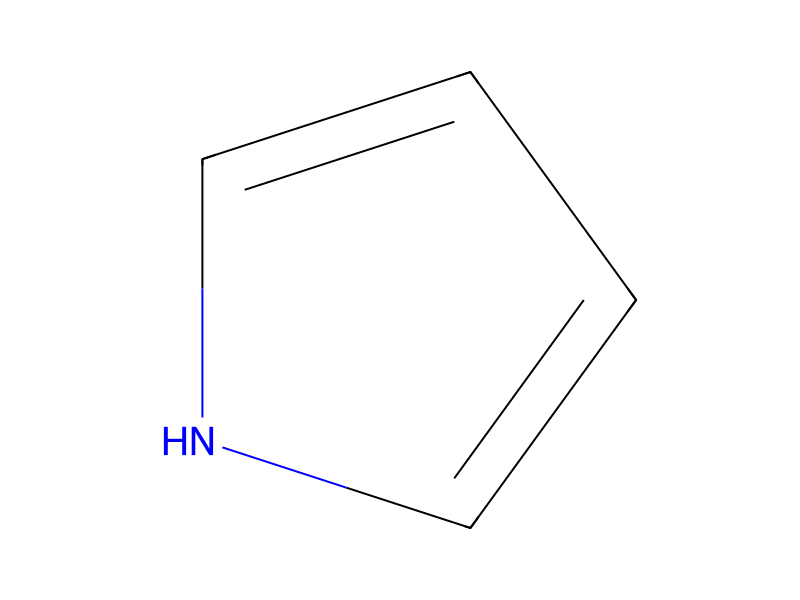






Procedure
A solution of 15 g (0.08 mol) monopyrrole nitro ester in 130 mL DMF was reduced over 5% palladium on charcoal (1.5 g) at atmospheric pressure. The solution was filtered through Celite to remove the catalyst and 20 mL triethylamine (0.14 mol) was added. A mixture of 15 g N-methyl-4-nitropyrrole-2-carboxylic acid 22 (0.09 mol) in 20 mL DMF was added with stirring. (N-methyl-4-nitropyrrole-2-carboxylic acid chloride was prepared by reluxing the monopyrrole acid in thionyl chloride until clear (~1 h) and removing excess thionyl chloride under vacuum.) The mixture stirred 12 h, 700 mL ice and water was added and the product was filtered off. After washing with water twice and diethyl ether, the light-green product was dried yielding 24 g (95%) of the dipyrrole nitro ester 20 (Bailer et al., 1978). NMR (DMSO-d6) δ3.75 (s, 3H), 3.85 (s, 3H), 4.0 (s, 3H), 6.9 (d, 1H, J=1.5 Hz), 7.5 (d, 1H, J=1.5 Hz), 7.6 (d, 1H, J=2.0 Hz), 8.2 (d, 1H, J=1.5 Hz), 10.3 (s, 1H).
Workup
- filtrationThe solution was filtered through Celite
- additionwas added
- additionwas added
- customuntil clear (~1 h)
- customremoving excess thionyl chloride under vacuum
- stirring) The mixture stirred 12 h
- addition700 mL ice and water was added
- filtrationthe product was filtered off
- washAfter washing with water twice
- dry with materialdiethyl ether, the light-green product was dried
Sources & evidence
- ORD record
- ord-f9d8429006994516bd7d3c75f8573354
- Source dataset
- uspto-grants-1990_07
- Patent number
- US04942227
Reaction notes
Loading…