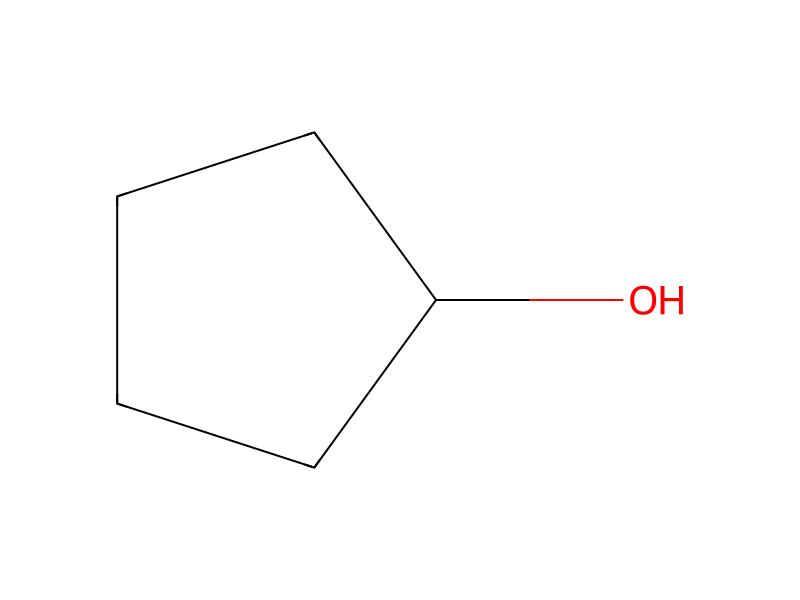
Cyclopentanol → HCID 86761716, compound
Reaction equation

[CH:1]1([OH:6])[CH2:5][CH2:4][CH2:3][CH2:2]1.[H-].[Na+].[C:9]([C:11]1[CH:12]=[C:13]([CH:16]=[CH:17][C:18]=1F)[CH:14]=[O:15])#[N:10]>CN(C=O)C.[Cl-].[Na+].O.C(OCC)(=O)C>[CH:1]1([O:6][C:18]2[CH:17]=[CH:16][C:13]([CH:14]=[O:15])=[CH:12][C:11]=2[C:9]#[N:10])[CH2:5][CH2:4][CH2:3][CH2:2]1Participants






Conditions
- Temperature
- 0 °C
Procedure
A solution of cyclopentanol (1.15 g, 0.013 mol), in DMF (50 ml) was cooled to 0° C. Sodium hydride (1.54 g, 0.016 mol) was added portionwise to the solution and the mixture stirred at 0° C. for 10 minutes after complete addition. 3-Cyano-4-fluorobenzaldehyde (commercial) (2.0 g, 0.013 mol) was then added and the mixture allowed to warm to room temperature and stirred overnight. The reaction mixture was cooled to 0° C. and brine was added, the mixture was diluted with ethyl acetate (˜25 ml) and partitioned, the organic layer was washed with water (˜30 ml) and passed through a phase separating cartridge to dry. The solution was concentrated in vacuo and the residue purified by Biotage SP4, 40M with 20-60% ethylacetate/hexane as eluant. The product containing fractions were concentrated in vacuo to yield the title compound (1.02 g, 4.2 mmol) as a yellow liquid. MS (ES): requires C13H13NO2 215; found 216 (MH+).
Workup
- additionafter complete addition
- temperatureto warm to room temperature
- stirringstirred overnight
- temperatureThe reaction mixture was cooled to 0° C.
- custompartitioned
- washthe organic layer was washed with water (˜30 ml)
- customseparating cartridge
- customto dry
- concentrationThe solution was concentrated in vacuo
- customthe residue purified by Biotage SP4, 40M with 20-60% ethylacetate/hexane as eluant
- additionThe product containing fractions
- concentrationwere concentrated in vacuo
Sources & evidence
- ORD record
- ord-03434c555293439f9d40506ef59112f9
- Source dataset
- uspto-grants-2012_12
- Patent number
- US08324254B2
Reaction notes
Loading…