Thiazolidinedione → HCID 16392506, compound
Reaction equation

[S:1]1[CH2:5][C:4](=[O:6])[NH:3][C:2]1=[O:7].[Br:8][CH2:9][CH2:10]O.C1(P(C2C=CC=CC=2)C2C=CC=CC=2)C=CC=CC=1.CC(OC(/N=N/C(OC(C)C)=O)=O)C>O1CCCC1>[Br:8][CH2:9][CH2:10][N:3]1[C:4](=[O:6])[CH2:5][S:1][C:2]1=[O:7]Participants
Reactant 4
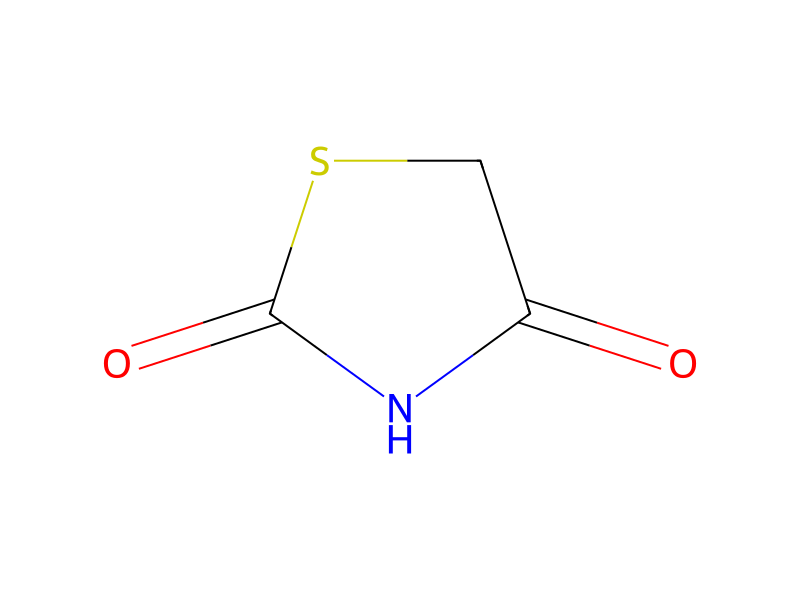


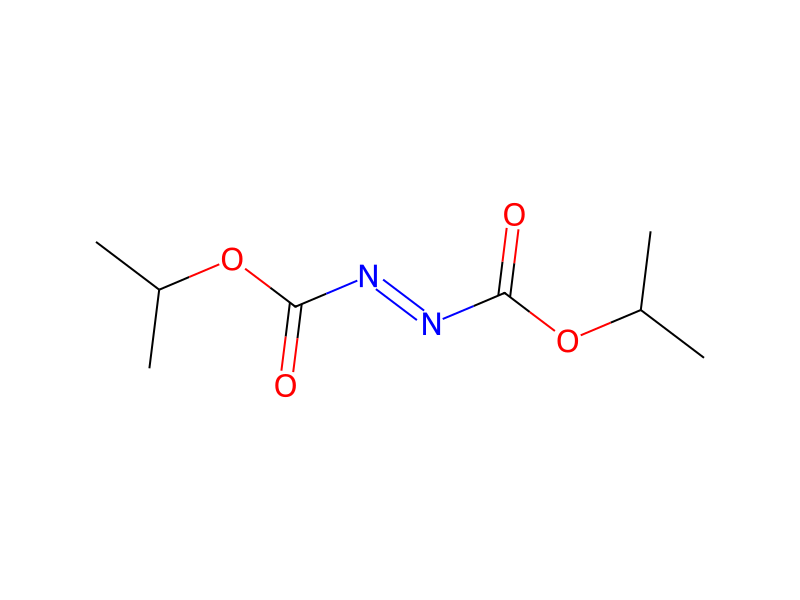
Product 1

Reagents, catalysts & solvents 1

Conditions
- Temperature
- 5 °C
Procedure
Into a 500-mL 3-necked round-bottom flask purged and maintained with an inert atmosphere of nitrogen, was placed a solution of 1,3-thiazolidine-2,4-dione (10 g, 85.38 mmol, 1.00 equiv) in tetrahydrofuran (300 mL), 2-bromoethan-1-ol (10.6 g, 84.82 mmol, 1.00 equiv), triphenylphosphane (27 g, 102.94 mmol, 1.20 equiv). This was followed by the addition of a solution of DIAD (21 g, 103.96 mmol, 1.20 equiv) in tetrahydrofuran (30 mL) dropwise with stirring at 0-10° C. in 30 min. The resulting solution was stirred overnight at room temperature. The resulting mixture was concentrated under vacuum. The residue was applied onto a silica gel column and eluted with ethyl acetate/petroleum ether (1/50) to give 9 g (47%) of 3-(2-bromoethyl)-1,3-thiazolidine-2,4-dione as a colorless oil.
Workup
- customInto a 500-mL 3-necked round-bottom flask purged
- temperaturemaintained with an inert atmosphere of nitrogen
- stirringThe resulting solution was stirred overnight at room temperature
- concentrationThe resulting mixture was concentrated under vacuum
- washeluted with ethyl acetate/petroleum ether (1/50)
Sources & evidence
- ORD record
- ord-8f97f7cf010243f989031386dcde54a4
- Source dataset
- uspto-grants-2016_06
- Patent number
- US09376438B2
Reaction notes
Loading…